
Thorns
Mixed-media





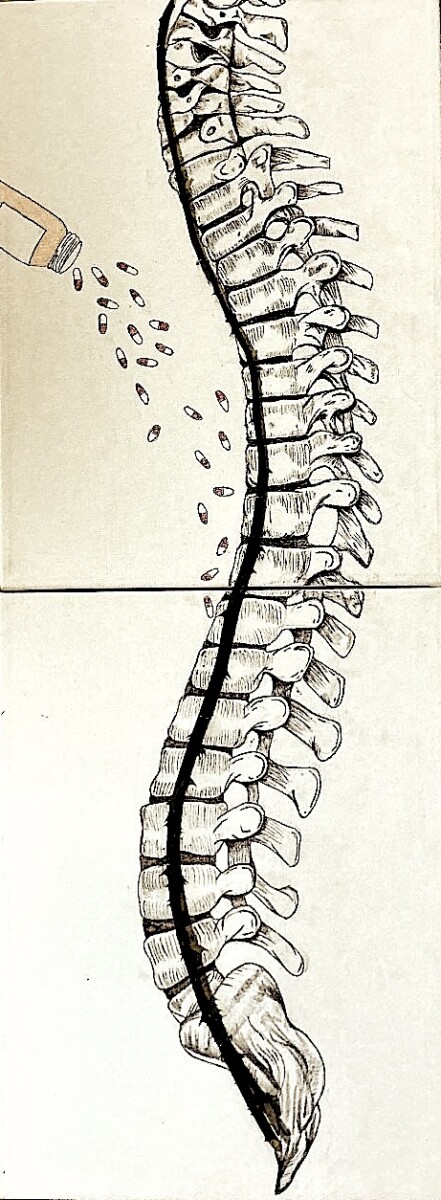
The patient who inspired this artwork was suffering from back pain linked to confirmed medical conditions but my GP believed their pain was not going to improve without first treating their underlying post-traumatic stress syndrome.
The thorn running up the spine is representative of how this patient’s pain developed as she grew up through childhood sexual abuse. The thorn embodies the curvature of the spine because it has become a part of her and she cannot separate herself from the trauma.
The patient had taken many pain killers to try and help her back pain, but their effect was minimal. I made a purposeful decision to include real thorns but represent the pills as two-dimensional drawings to emphasise the fact that the trauma is painfully prominent in this patient’s life and the pain is too complex to be fixed by a simple pill.
People underestimate the impact severe trauma can have on the body as well as the mind, and this patient’s entire life was affected by her trauma. She described to me how even showering was painful – the water feeling as if it were puncturing her skin.
Most of us will, fortunately, never be able to understand just how much trauma shapes a person, nor the extent of the mental and physical pain it creates, but I wanted to use my artwork to try and capture the complex relationship between trauma and chronic pain syndromes.
Joint third place prizewinner, Effective Consulting Creative Assignment, Year One 2025/26
I think this piece shows well how psychological pain can manifest itself physically. I see the thorns as not only what’s giving the sensation of pain but also that they can get “stuck” in the person needing considerable time and effort to remove. This in my view is representative of the journey one must go on to heal from a severe trauma as it takes many small moments of healing to be at ease with a traumatic event.
I also notice how part of the thorny spinal cord is outside the vertebral column. This could be showing how those recovering from such an event are more exposed to further harm despite trying to heal. This demonstrates how it’s not a process that can easily be undertaken alone and that the patient needs support from loved ones in order to fully recover.
I think this is a really nice piece of artwork because it shows how trauma can affect someone physically as well as mentally. I like how the thorn follows the shape of the spine because it shows how the trauma has become a part of the person’s life and isn’t something they can easily escape from. It also makes the spine look quite uncomfortable and painful, which links well to the patient’s experience.
I also think using real thorns but drawing the tablets is a really clever idea. It shows that the patient’s pain is much more complicated than just taking painkillers and that medication might not always solve the problem. The contrast between the two also makes the thorns stand out much more, which draws your attention to them.
It was quite shocking to read that even something as simple as having a shower was painful for the patient. I think this helps the viewer understand just how much the trauma affected her everyday life, rather than just thinking about it as something that happened in the past. It also shows how something that might seem like a mental health issue can have a very real physical impact.
Overall, I think the artwork does a good job of showing how much someone’s past experiences can affect their everyday life. It also reminds us that pain isn’t always straightforward and that understanding the person and their experiences is just as important as looking at their physical symptoms.
This piece elegantly shows the complex long term health effects of trauma. The pills being 2D highlights how the effects aren’t helping at all and feel as if they are barely real. The thorns having been through the entire spine as well as positioned differently within the spine demonstrate the immense complexity of her mental and physical health as well as how it has changed her throughout life. This highlights how such situations should be approached with compassion and care and how that could even be more valuable than the medication itself
I like this artwork because its able to show the link between chronic pain and trauma in a startling yet elegant way. The use of the spine in the artwork obviously refers to the chronic back pain the patient experienced, but can also be used to show how trauma (the thorn) is able to latch onto the most essential parts of yourself and your identity, the very things that keep you standing upright day to day. The thorn are perfectly adhered to the spine, showing how trauma can almost become part of your identity at some points. Some of the spikes also point outwards from the spine, showing undealt trauma can also cause external harm to your relationships with other people in your life.
The use of dimensions within the artwork is particularly interesting. Having the thorn be in 3D whilst the pills are 2D is a very visual way of displaying how complex trauma is and how medication alone is unable to have an effect. You have to dig deeper, under the skin, to find the real human cause sometimes.
This piece is beautiful, the contrast between the meticulous detail of the spinal column paired with the cartoonish pills is a tactful representation of how futile efforts can be when damage is already done, the fluid shapes and curvatures of the spine unaffected by the intervention is really poignant. The complexity of the natural element of the vine innervating the spine showing the complexity and deep roots of her condition was masterful.