
Panic
Parmida Rahimighane
Drawing





During one of my Health Care Assistant shifts, a patient asked me to help them get up. However, while I was in the room, they felt very, very unwell and said that they couldn’t breathe and that their chest felt tight, so I immediately went and called one of the nurses. When the nurse came in, the patient was almost unresponsive and staring at the ceiling. All quickly escalated to the point where the emergency buzzer was activated and the patient was considered likely to be having a cardiac arrest.
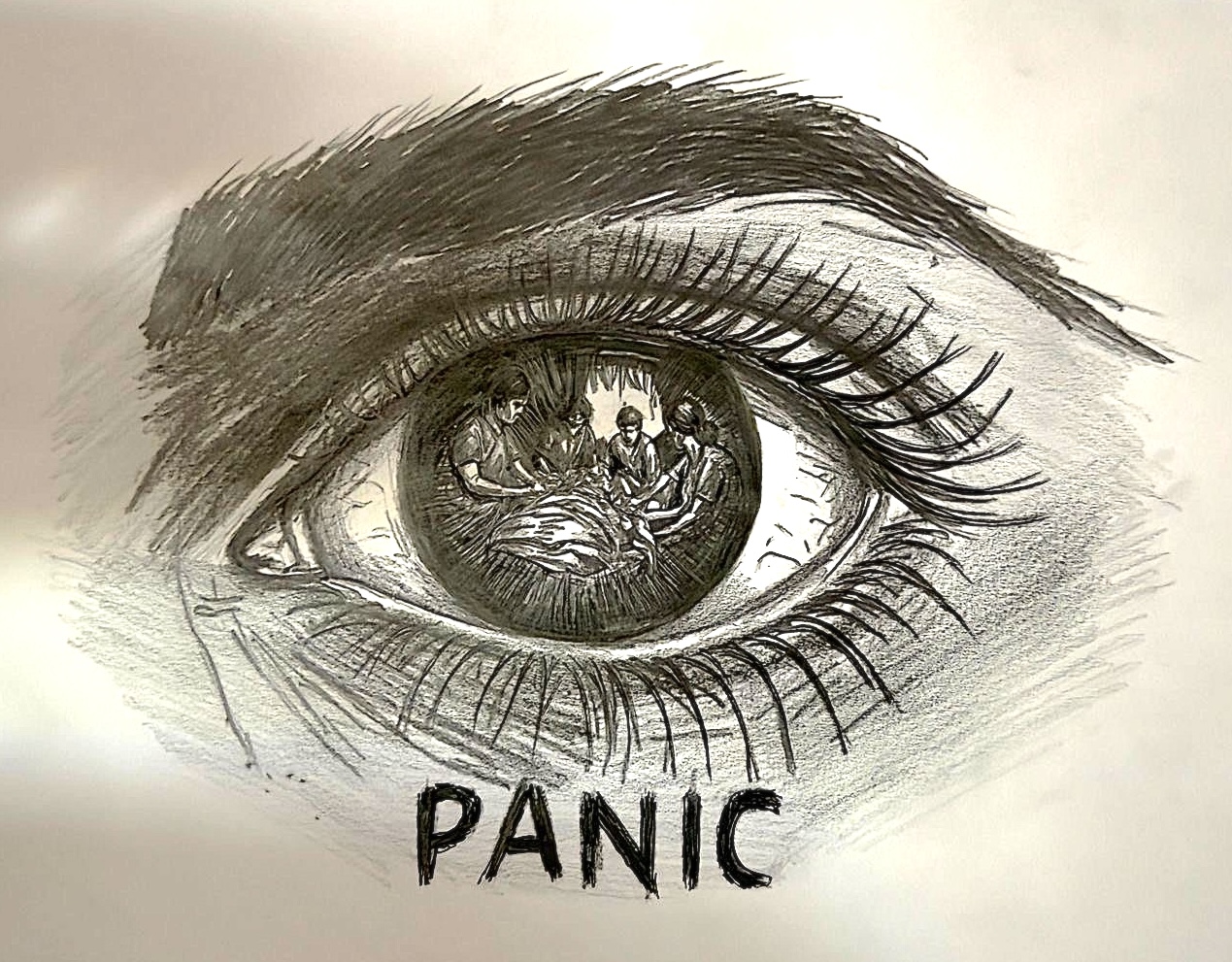
This was my first time experiencing such a difficult situation, and it was also the first time I realised how critical and important a clinician’s job is. I chose this encounter because it had a strong emotional impact on me and stayed in my mind. After the shift ended I decided to draw this image and this is my eye. Through my eyes, you can see the room and how many nurses and doctors were all around the patient, trying to help them and save their life.
I chose to represent this through an eye to show my perspective and how I experienced the moment both visually and emotionally. I was very scared and panicked. I realised that I felt overwhelmed and unsure in a high-pressure situation, but I still remained present and tried to respond by getting help quickly.Creating the drawing helped me reflect more deeply on the experience and process my emotions. However, I also realised that this experience is probably very common and normal among clinicians, and I may encounter many similar situations throughout my medical school journey and after I graduate as a doctor.
(click on the image to see the full details!)
Joint Second Prizewinner for the Effective Consulting Creative Assignment, Year One, 2025/26
The artwork made me reflect on the different perspectives of patients and healthcare professionals. What might be a routine situation for medical staff could be an incredibly frightening and overwhelming experience for a patient. The word ‘PANIC’ and the image within the eye highlight how differently the same situation can be experienced. It reminds me that what might be an ordinary day for us could be the worst day of somebody else’s life. I think it is important to recognise the privilege we have in supporting people during these vulnerable moments, whilst remaining calm and reassuring, even when we may be experiencing difficult emotions ourselves.
This piece is particularly moving for me as it captures the emotional side of working in healthcare, rather than just the clinical reality of a medical emergency. The emergency scene reflected in the eye is a really creative way of showing how the artist personally witnessed and remembered the experience.
As a medical student, this artwork makes me reflect on how I might feel when witnessing a medical emergency. Though I often learn about emergencies through readings and lectures, experiencing one in real life must be very different. The drawing demonstrates to me that it is important to recognise that healthcare professionals are human too, and can feel frightened or overwhelmed despite their clinical responsibilities.
I find it powerful that the artist does not hide their vulnerability. It serves as a reminder that developing into a good doctor is not just about gaining medical knowledge, but also learning to cope with difficult experiences, managing our own internal feelings alongside supporting others during vulnerable moments.
The artwork made me think about how a single clinical experience can have a lasting emotional impact, particularly when witnessing a medical emergency for the first time. I found the use of the eye particularly interesting, as the scene reflected within the pupil allows us to see the situation from the artist’s perspective, almost as though the memory has been permanently captured in their mind. The contrast between the dark shading and the lighter areas, alongside the word panic, effectively conveys the fear and uncertainty they experienced. It also highlights the importance of recognising our own limitations, seeking support from colleagues and teamwork in high pressure situations. I think it is important to develop the ability to remain composed during challenging moments without losing the emotional aspect of medicine.
This piece highlights how overwhelming a hospital environment can be, regardless of if you are there as a healthcare worker or a patient. The eye reflecting the healthcare professionals doing what would be simply part of their job with panic written underneath shows how even healthcare workers may struggle with the gravity of their jobs. This piece is made more powerful by depicting the scene within their iris, showing how they may feel helpless in this situation, causing them to panic more. From this artwork, I think that it is important to remember that healthcare workers are still human, and encourage them to reflect on their emotions after a difficult shift as prioritising your mental health is of the utmost importance when you are doing a difficult job.
This piece highlights the personal, human side of healthcare that you can’t prepare for. The overwhelming feeling in a situation that you haven’t experienced before, not knowing how you can or should help. It also portrays how quickly things can change and if you’re not prepared for it, can be very daunting and quickly transport you into a state of ‘panic’. This piece stood out to me as I’ve felt this exact way before, witnessing something that’s completely new to you, knowing you should and want to help, but frozen in place, with the whole situation swallowing you up, leaving you with nothing to do but watch.
This piece particularly stood out to me due to the stresses and pressures put on clinicians – the panic is emphasised through the dark colours of the piece, and the distance portrayed of the person to the healthcare professionals, demonstrating how they may have felt powerless and out of touch within the situation. It highlights the difficulty that doctors have to face regularly and take in their stride, and the long journey that medical students have in front of them to, in time, experience these situations without the panic shown in the art piece.
This artwork regarding panic gave me an insight that as medical professionals we will encounter highly stressful situations. In this situation a rapid deteriotion in health required quick thinking and remaining calm.
The reflection of the eye demonstrated the individual’s visual experience of how healthcare professionals cooperate effectively and rapidly to help the patient.
The artist here stated that they were overwhelmed and stressed but being able to manage and get help was the most important part.
This made me realise that in the future I will encounter many situations like this and developing coping and management strategies early on will be essential in clinical environments.
What I found most powerful is how well it captures that first moment of panic, when you are frozen in shock. The eye is wide open and staring, almost paralysed, and the person is only watching while everyone else acts. The word “PANIC,” written bluntly underneath, says what the person can’t put into words in that moment.
I found this both unsettling and reassuring. It reminded me that freezing in shock is a very human reaction that many clinicians have probably felt at the start of their careers. It also made me think about how training and experience help turn that frozen observer into someone who can step forward and act.
I love how you can actually see the panic in the eyes and see the fear in the student. Made me think of the possibility of getting overwheming situations during placements and the daily scary life of docs of
This artwork had a profound impact on me. Inside the iris, I see a miniature surgical team at work. I think the placement is significant as the surgery is happening inside the person looking out. It implies that for a patient, this event consumes their entire worldview. Their existence is narrowed down to that single room and that single procedure. The tiny figures of the surgeons suggest how small we are in the face of biology, yet how monumental our interventions are to the individual.
Overall, I believe the image capture the psychological and emotional reality of healthcare