
Watchful Waiting
Rebecca Pimblott
Mixed-media





A young male presenting to the GP with a history of anorexia nervosa, a low BMI, and associated psychological stressors. The mental health team has identified no immediate risk to the patient’s health. The patient has not met the correct criteria for secondary care referral. The patient has been discharged back into the community. But I don’t want you to remember him like this. It’s clinically accurate, but it’s not what I saw.
He didn’t “present”. I saw him walk in. He looked nervous. He told me that he had nobody. He told me that he couldn’t tell his family he was gay. The only thing he felt he could control in his life was starving himself.His “psychological stressors” weren’t a symptom; they were his entire life silently falling apart. And despite all of this, the NHS had looked closely at him and decided that he did not need any help.
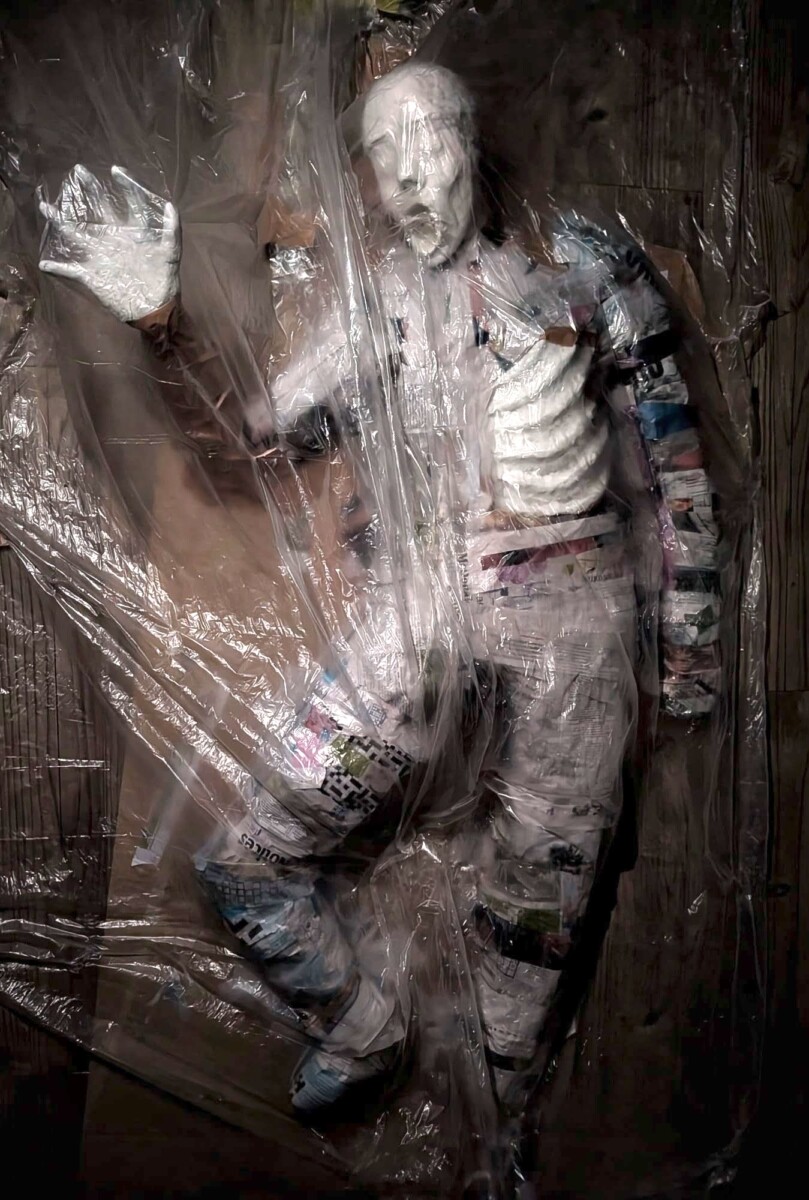
This piece is my attempt to sit with the helplessness I felt when talking to him. A model built out of paper mache and clay, closer to the size of a young boy, mouth open, his hand reaching out for help. The plastic sheet shows not only suffocation but also the transparency of it all. The NHS can see him clearly. They are just choosing not to act. There are thousands more like him. He is not special in that sense, yet his life felt far too special to just throw away. Perhaps it is too late for this patient, but I pray that one day the NHS will have the power to support others like him.
Joint second place prizewinner, Year One Effective Consulting Creative Assignment, 2025/26
This piece had a profound impact on me due to its striking and harrowing appearance. The model seemed suffocated and restricted as it reaches out screaming and almost resembles a crime scene. Upon reading the description, it highlighted the flaws of the NHS and the cold, open ignorance that the patient experienced when he obviously required help. It attacks the criteria for referrals and demonstrates that a checklist is not able to fully understand the patient at hand. It strips the humanity out of clincal practice and is unforgiving. It leads to thousands of patients struggling and feeling helpless as demonstrated by the appearance of the model. The ribs and cheekbones are showing, demonstrating the patients struggle with anorexia as a way to cope with his other psychological stressors. His identity as a gay male further exacerbates his deteriorating mental health as he is worried about the pressures of his family. To me, it shows how the NHS’s criterions has created a middle ground where patients with symptoms are suffering but not suffering enough to be considered for treatment. It also will probably lead to patients losing confidence in the healthcare system.
This piece really stuck out to me due to the overwhelming sense of horror eminating from the man’s face. It gives this sense of hopelessness, as the man is reaching out for help from his GP, revealing vulnerabilites about his personal life yet is declared ‘not sick’ enough for treatment. His whole life is ‘falling apart’ yet just placed under the umbrella term of psychological stressors, ignoring the person behind the illness. The clear film truly helps encapsulate the sense of a system that can see its own flaws but still allows patients to fall between the cracks. Eating disorders are such complex illnesses that have such profoundly devastating consequences to individuals and those around them which this artwork displays. The hopelessness this student feels truly comes across in this piece, the patchwork nature of the man displaying how there are so many patients with anorexia nervosa or histories of such that are let down by the NHS referral system. Yet the focus on the one silhouette in the piece centres on the complexities of this patient as a whole, the individual’s own identity of being a gay man who couldn’t express his sexuality to his family compounding his isolation and deteriorating mental health, showing how entangled mental health can be. Overall this artwork really showed the stark realities of limited NHS support for complex cases reflected in a harrowing piece.
The raw distress conveyed in this piece caught my eye: the agony written all over the face with its mouth agape, the starkly visible ribs, the unsettling, outstretched hand trying to pierce through the transparent film, all of which evokes a sense of helplessness. The sheet prevents both his voice from being heard and his hand from reaching out to get someone’s attention – it traps him, partitioning him off from the help he needs, yet still leaving him entirely in view of the onlooker. This powerfully encapsulates what the patient that Pimblott details in her description may have felt, a patient whose life was ‘falling apart’ and evidently needed help but was merely dismissed by the NHS system. In the words of the musical Dear Evan Hansen, ‘[He] tried to speak but nobody could hear.’ This piece certainly provides substantial food for thought on the profound impact of the failures of the NHS on individuals and considering Pimblott’s suggestion of the sheer number of patients who may have had a similar experience, this picture that she paints with her piece is truly alarming.
To me this perfectly sums up mental health services in the NHS, the very strict criteria leave so many people excluded from receiving support – even though they need it so desperately. This piece shows so clearly how he wants help & the system sees that but wont provide it – and the impact / potential impact on them.
What drew me to this piece was the striking look on the man’s face, as he reaches out for help. The sense of desperation and helplessness is amplified by the outstretched hand behind the sheet as well as the very visible ribs. Upon reading the description, it is clear that the artwork demonstrates how easy it is to be left behind by the NHS, when he is very clearly yelling for help. It is devastating to see how easily large pressures are hidden behind the term psychological stressors’, while nothing is done about it. I would be very interested to see how many other patients have fallen between the cracks like this one.