
The Shape of Grief
Demaa Aldrubi
Mixed-media





The patient described a period of profound loss. Following the death of their father, they were quickly faced with their daughter’s cancer diagnosis, leaving little time to process their own grief. They moved almost immediately into the role of caregiver, suppressing their emotions to support their child. It was only after their daughter’s death that the full weight of both losses emerged. They described feeling emotionally ‘empty’ and physically ‘unwell’, later developing chest pain and palpitations and being diagnosed with Takotsubo cardiomyopathy, known as ‘broken heart syndrome’.
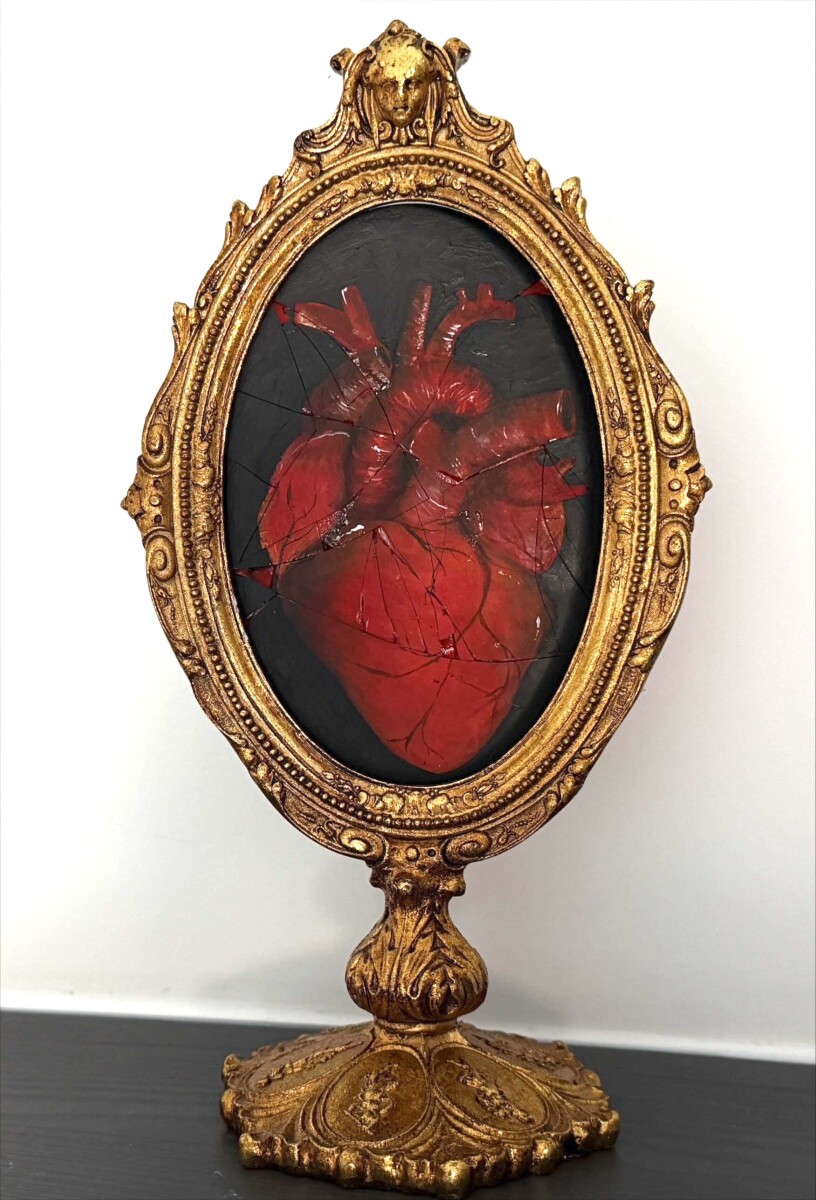
Rather than portraying the medical condition itself, I wanted to portray the person behind it: their grief, love, loss and survival.
I chose a vintage-style picture frame to represent memories that we preserve but cannot return to. At its centre, an anatomical heart is painted onto glass. The glass symbolises vulnerability and fragility; although the heart initially appears whole, its surface is fractured. I deliberately shattered and reassembled the glass, leaving the cracks visible. These fractures represent unresolved grief and the lasting impact of loss. Some fragments were left missing, symbolising the permanent absence of loved ones. The ornate, stable frame contrasts with the fractured heart within it, reflecting how the patient appeared outwardly strong while carrying hidden distress. Yet the heart remains standing. Rather than portraying healing as a return to wholeness, I wanted to show it as learning to continue despite being permanently changed.
This experience taught me that grief is not always visible or immediately expressed. It reinforced the importance of listening, emotional presence, and recognising patients as whole individuals, including the wounds that may remain unspoken.
First place prizewinner, Year 1 Effective Consulting Creative Assignment, 2025/26
It’s extremely important for clinicians to recognise that grief isn’t a linear process so that they can support patients and their families through the process. The visual representation of the lasting effects of grief through the shattered glass are also very meaningful and shows that grief is not always visible.
I think that this piece effectively portrays grief as having a profound effect on individuals. I like the use of the broken glass which can’t be fully fixed, showing the lasting impact of grief on the person.
This highlights the importance of healthcare professionals understanding that the individual’s situation will continue to affect them, as the clinician only sees a fragment of the individual’s life during an appointment and may not be fully aware of their life situation . This means that clinicians need to have a holistic view of healthcare when treating patients and talking to their family members to be able to support them.
Very thought-provoking artwork.
What spoke to me most about it is the idea that healing does not necessarily mean returning to the person someone used to be before their loss.
The reassembled glass being visibly fractured suggesting that although a person can continue living and find ways to adapt, significant experiences can permanently change them, is especially beautiful, and I think this is a more realistic representation of grief than the idea that it follows a predictable process of ‘healing’ with a clear endpoint.
In a medical setting as well, I think it highlights the importance of having an empathetic approach to the patients to be able to listen beyond what they explicitly tell you, in order to get the full picture.