
First 30 Minutes
Vakare Zalieckaite
Painting





Thirty minutes into my twelve-hour Health Care Assistant shadow shift I had to watch my HCA clinical mentor clean and cover a patient that had passed away an hour beforehand.
Whilst I only knew that she had passed due to a fall-related injury and was on end of life care, I felt a great deal of emotion watching this process. My mentor constantly showed respect, introducing herself and talking the patient through the bathing and dressing process as if she were still with us. I hope to be able to carry this respect with me as I grow through my healthcare career.
Unfortunately, my grandfather had passed away the week before. However, since he lived in a different country and the fact that I struggle with visualizing and found it difficult to comprehend that he was actually gone. Seeing this process, I finally realised what actually happened to my grandfather and it felt like I had gained some closure.
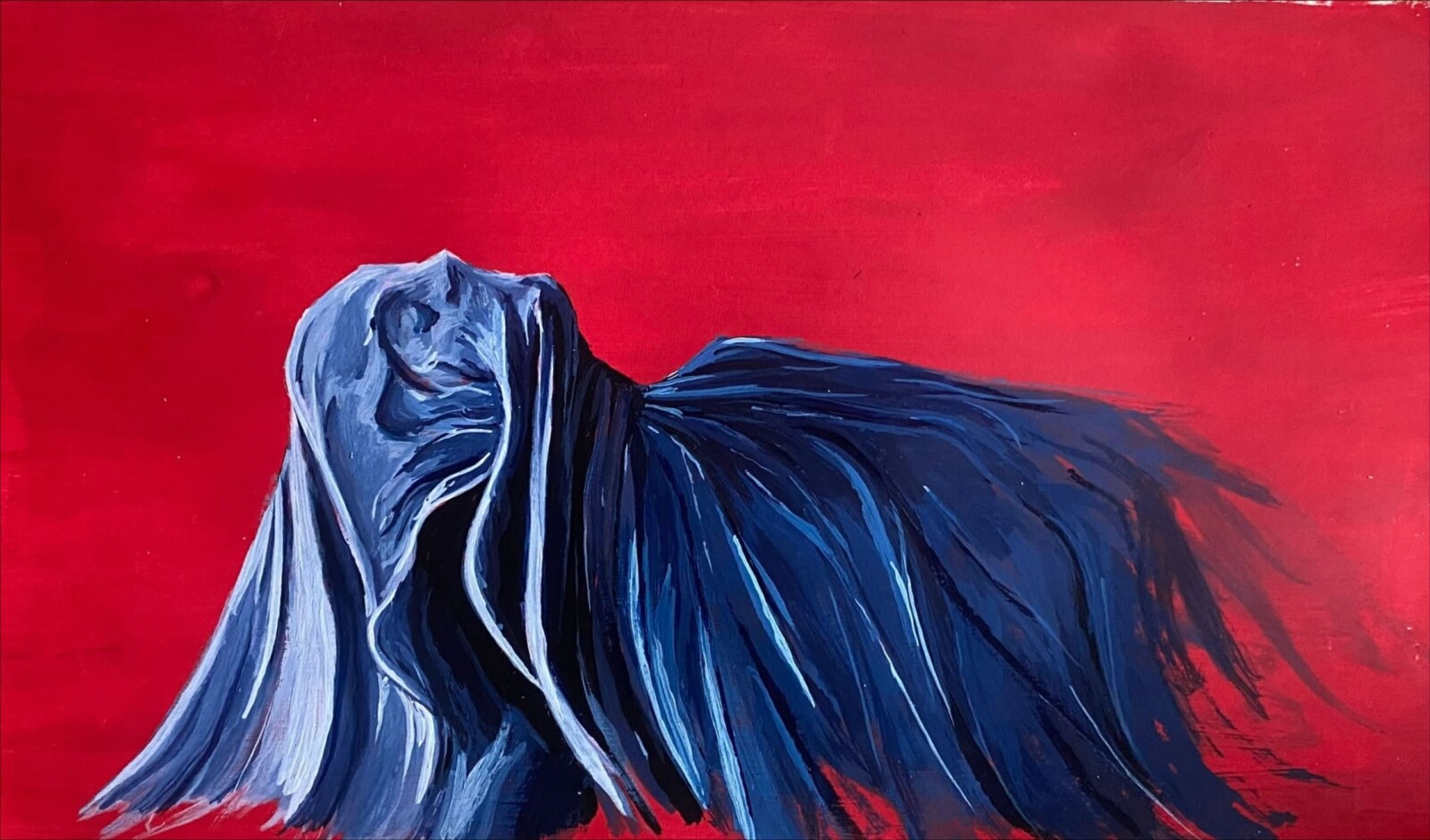
I wanted to create this piece to show the vibrant emotions I felt leaving the room – whilst everything was a single shade of white, except the single piece of coloured paper lying on top of the patient signalling that she was ready to be transferred to the morgue. The blue sheet contrasted with the red background implies the difference between oxygenated and deoxygenated blood. The flow of the sheet flows signifies the fluidity between states of living and deceased.I painted the lower end fading away to represent the loss of memory people face once grief has begun to pass.
As I closed the door behind me, it felt like time had stopped, as she lay there in the ultimate state of peace.
Joint third place prizewinner, Effective Consulting Creative Assignment, Year One, 2025/26
I thought this was a beautiful piece, both in its execution, which was imaginative and poignant, and in the story behind it. It showed how the student brought their own biography into the clinical situation in a way that was mature, reflective and potentially healing. I particularly appreciated the student’s recognition of the nursing colleague and the dignity with which they approached the care of the deceased person.
I love the intense contrast between the patient and the background, drawing attention to her and her passing. The way the sheet doesn’t hide her face i think does a great job of highlighting her humanity and that she’s not just a dead body, and her expression of peace serves to comfort us in her acceptance of of the inevitability of death, which makes a painful event less distressing. I am glad you felt some closure for your grandfather through her passing, and chose to honor her in this beautiful piece of work.
The poignancy of this piece “First 30 Minutes” reveals itself through the almost vibrant choices of colours, the bright red background could symbolise the strength of the emotions that the student felt, as it is strong and impactful. Interestingly, the colour red is often associated with emotions of rage or anger, but the artist contrasts these typical connotations with presenting the recently deceased patient as peaceful, and shrouded in what appears to be an almost translucent covering. This choice to present the covering as translucent, could show how despite the patient’s death, the artist still sees them distinctly as the person that they saw in life, which shows the artist’s deep respect and understanding of the beauty and transience of human life, which is a very developed perspective for a student experiencing losing a patient for the first time. The mixture of blues and whites that the artist has used to signify the shroud covering the patient, represent heartfelt emotions, signifying the immense melancholy of the loss of this patient but also how the artist is viewing this scene with a sense of tranquility, and sees the death of this patient as deeply emotional, but also regards it with a sense of peacefulness, and grateful consideration towards the medical professions who retained the patient’s humanity even in death.
I think this is a striking piece in both the way it has been painted and the context surrounding it. The way the covering seems to cling to their face whilst draping off of the rest of their body particularly stands out. To me, it conveys the person’s humanity, as our faces are irrevocably tied to our identity and expression. The choice of blue for the figure emphasises the “ultimate state of peace” that the student noted in the description of the artwork. The reflection on the student’s own personal experiences in relation to their experience in the clinic is also thought-provoking.