
Halfway to Whole
Sally Naser, Keiran Hall nd Daniel Tang





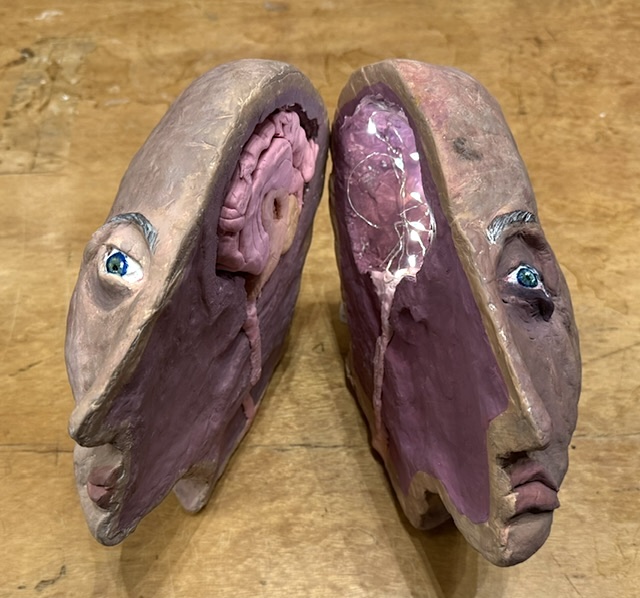
This clay sculpture focuses on the neuroplastic nature of the brain that aids its recovery following a stroke – the brain’s ability to change and adapt in response to experiences.
We wanted to illustrate both the disease and recovery of a stroke patient through a physical medium.
We chose clay to form the exterior head; one side of the face is notably drooped; a common characteristic associated with strokes.
One half of the brain includes plasticine to convey its versatile nature, and to allow the audience to interact with and mould it, portraying how a patient’s external environment shapes their recovery.
In the other half of the brain, fairy lights were used to represent neurogenesis (growth and development of neurons); the lights also symbolise hope of recovery despite the physical and mental hardships that patients experience.
The goal of our art piece is to appreciate the resilience and strength of individuals’ afflicted by stroke, and that of the brain, where it can rewire itself and adapt to disease.
Foundations of Medicine Conference, Collaborative Creative Piece, Year One 2025/26
I love many aspects of this piece, in particular how we can see how a stroke impacts the brain and how it presents externally.
The use of differing materials within the piece is very imaginative, and I think it gets across your point about neuroplasticity and how things around us shape it. Also, it makes it interactive, which is seen throughout your art piece and something I don’t think is seen enough within art.
Furthermore, using fairy lights to show new neural connections and hope is, I think, marvellous and is executed perfectly. It really gets across your point about resilience and the mental toll of illness, but also how strong our brain is and how it can recover from the harshest of diseases.
All in all, I think you perfectly executed your brief. Very good job.
I really like the fact that different materials were used to convey different aspects of the human mind and making it interactive highlights a human touch that a lot of other artwork does not always convey. Showing off neurogenesis with fairy lights was also an interactive way that wasn’t as hands on but it achieved a similar effect on viewers which shows how the brain can rewire itself. A slight touch I liked was the fact that the 2 sides of the brain were asymmetrical which shows off how the brain changes and adapts to having a stroke which subconsciously makes it aware to the viewer.
Another big area I liked was the different sides of the face displaying different features such as drooping, which while is a symptom of a stroke, could be seen as the persons mental state after suffering a stroke. Another touch is that the 2 sides of the head are not connected which highlights a fractured mental state. In addition to this, recovering and bringing the 2 sides together will leave a scar, showing that while recovery can happen, it will have a lasting impact on their lives for the future. I think that the goal for this piece showing the resilience and strength of individuals was certainly achieved through this design.
Overall the subtle ideas as well as the more apparent ones make this piece interactive and makes you think and appreciate human resilience and the complexity and adaptability of the brain
This piece is interesting as it shows multiple aspects of the brain and the struggles associated with suffering a stroke.
The use of clay to represent neuroplasticity is a subtle yet significant touch, and emphasises the brilliance of the design of our brain to regenerate and recover after suffering a stroke.
The fairy lights highlight the brain’s neurogenesis and along with it representing hope, makes it a powerful design choice.
Through this the mental impact of a stroke is portrayed, but also the physical impact, as the drooping of one side of the face is shown.