
Bone to Stone
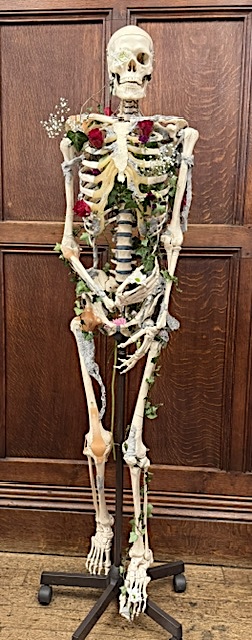
Maliha Rafi, Sami Nassr, Sarah Hallam and Sienna Edge
Mixed-media





Every year, instead of becoming more independent like normal kids would, I became more dependent,’ said Kathleen Degenhardt (Patient Voice, 2023). From the center of her body, the overgrowth of bone spread outwards, entrapping all caught in its path. As each limb seizes like stone, the lively motion of childhood becomes statuesque. Fibrodysplasia Ossificans Progressiva also known as Stone Man Syndrome, occurs in less than 1 in a million births. Those with this rare genetic syndrome cannot properly heal as the body will mistakenly replace muscles, tendons, and ligaments with bone. Most will grow to depend on external assistance for their activities of daily living.
To illustrate how this genetic condition holistically restricts aspects of a person’s life, we first established an artistic rendition of an afflicted skeleton. The external sheets of stone mimicked the excess growth caused by the condition while becoming platforms for hooks and plants. We chose to intertwine living vines between these hooks and around the bones to symbolize both restraint and excess, mirroring how the uncontrollable growth of living bone leads to immobility. Between the vines and spotted all over the body flowers of different varieties and meanings bloom. We chose white gypsophila, representing purity; pink and white daisy chrysanthemums, representing patience; and dark red roses, representing a deep desire.
The skeleton covered with vegetation appears akin to a stone statue lying within a park. It weathers through the seasons becoming ingrained with the soil as the days go by. We wanted to show a more serene side to Stone Man Syndrome while keeping the details that make it unique. For many, this will be the first time hearing of such a condition, so we wanted to present it for increased awareness. Despite their physical stagnation, the stories of those with Stone Man Syndrome moved us to create art in their honor.
Sources:
Foundations of Medicine Conference, Collaborative Creative Piece, 2025
0 Comments