
Ticking Time-Bomb
Anonymous





A woman in her 80’s had been struggling with her heart since 2022. During the same year, she lost her sight within one week. Alongside her heart diagnosis, this felt like an impossible circumstance and was extremely hard for her to cope with. She explained that she felt that the stress of all this was the cause for the end in her marriage. Three unimaginable events happened to this woman in a matter of months -and she was not able to predict any of it.
She shared that she feels very hopeless and concerned about her own health. She was worried she might not ever be able get the procedure before it is too late and was very tired of being an in-patient at two hospitals.
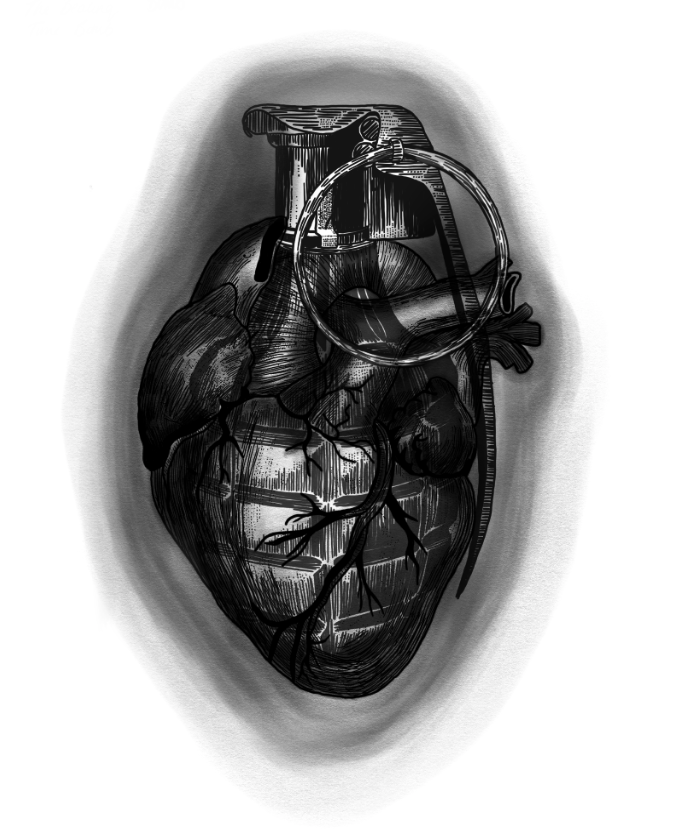
I decided to creatively explore how she is living with a heart which is a ‘ticking time-bomb’. There is nothing to say for certain that her heart will stay in a stable condition long enough for her to receive the appropriate treatment. All she has, is waiting and hoping that it doesn’t ‘go off’ before she is able to receive the surgery.
I chose to use a grenade to symbolise this predicament as I feel they can be unpredictable, just like her heart. This also links with the many stories she generously shared with me about her previous employment in the Royal Naval Service.
Effective Consulting Creative Assignment, Year Two, 2025/26
I really enjoyed looking at this piece. The image of the heart and grenade combined is incredibly powerful and really shows the precariousness of the patient’s experience. The use of black and white and the shadows surrounding the grenade feels very somber and quite ominous, which gets across the fear the patient must feel faced with her prognosis.
This illustration stood out to me as it brings together the ideas of life and death. Grenades are often associated with war and therefore death, while the heart is a vital organ which gives us life. Combining the two highlighted for me how the patient may feel on the waiting list: knowing that her heart could fail without warning. The way the heart and the grenade are intertwined also shows the complexity of her situation, as she navigates her heart disease, sudden sight loss and the breakdown of her marriage. This highlighted to me the burden of waiting and that patients are dealing with much more than a single diagnosis.
The piece ‘Ticking time Bomb’ reflects a patient’s feeling of apprehension and fear for the future after diagnosis – and how nothing can prepare you for what may be ahead.
The monochromatic colour scheme focuses on the heart in a shadowy, disquieted fashion reflecting how diagnoses can come without warning in a dark and harrowing way.
The imaging of the heart as a grenade further implicates the unpredictable nature of one’s health and how abruptly this health may decline- and how this decline may be ultimately detrimental to the patients physical, mental and social wellbeing as they see their lifespan narrowing and relationships tested through these difficult periods.
The amalgamation of the heart and grenade additionally gives a striking contrast with the 2 objects essentially being opposites. The heart is heavily associated with life and emotion and the grenade associated with violence and destruction. By creating this hybrid between the 2 forms the artist essentially creates tension which mimics the apprehension and fear faced by patients when they come to terms with their diagnosis.
As the piece has no other distractions and it is placed on a clear white background, this isolated the heart-grenade complex is seen to be vulnerable and isolated – two feelings synonymous with gaining information about a new life-threatening condition.
The piece ‘Ticking Time Bomb’ reflects a patient’s feeling of apprehension and fear for the future after diagnosis- and how nothing can prepare you for what may be ahead.
The monochromatic colour scheme focuses on the heart in a shadowy, disquieted fashion reflecting how diagnoses can come without warning in a dark and harrowing way.
The imaging of the heart as a grenade further implicated the unpredictable nature of one’s health and how abruptly this health may decline – and how this decline may be ultimately detrimental to the patients physical, mental and social wellbeing as they see their lifespan narrowing and how relationships are tested through these difficult periods.
The amalgamation of the heart and grenade additionally gives a striking contrast with the 2 objects essentially being opposites. The heart is heavily associated with life and emotion and the grenade associated with violence and destruction. By creating this hybrid between the 2 forms the artist essentially creates tension which mimics the apprehension and fear faced by the patients when they come to terms with their diagnosis.
As the piece has no other distractions and it is placed on a clear white background, this isolated heart-grenade complex is seen to be vulnerable and isolated – two feeling synonymous with gaining information about a new life-threatening condition.
This piece is very well illustrated, it reflects how a time sensitive situation weighs heavily on an individual’s mind and emotions. The heart is a grenade, capable of exploding at any moment. The pin has not yet been pulled, there is still time to help this patient, but it is always the feeling of anticipation as who knows when their condition could become unstable, and whether or not they will receive the treatment in time. The piece being in black and white demonstrates the shift in perspective to a much darker one due to the 3 events that happened so fast over a period of months, it’s almost as if a light or happiness has been lost. The heart also casts a deep shadow over the white page, as it is weighing heavy on the situation and the patient’s mind. My interpretation is that the situation has been going on for some time, long enough for the blood vessels to grow over everything, to spread and cover it as if they are trying to forget about the situation. The organ which was supposed to give you life is now a major threat, contrasting the themes of life and death.
This piece beautifully illustrates how closely intertwined life and death are, and how unpredictable events shape up to leave even things as constant as a heart beat uncertain. The black and white colour scheme however contrasts this lack of predictability with a steadiness shown through its absence of colour implying to me that only two things are certain in life: life and death, hence suggesting that whilst there is an uncertain ease about how some events happen it can be guaranteed that death will eventually occur, suggesting that the heart and life itself cannot escape the inevitable future.
This is a remarkable piece that gives connotations of being a hostage within your own body unsure of what happens next and how long you have.The black and white shades are very powerful in illustraiting the sense of fear and urgency many patients feel when encountered with health problems, leaving the observer with a underlying sense of gloom. The juxtaposition of the “life giving heart” next to a symbol of war and destruction further demonstates the patients resentment to their struggels and the fear they entail. Although the pin hasn’t been pulled, meaning there is still time, one wrong move could set it off alongisde the looming fear for the rest of ones life.
It is a great piece to highlight the feelings of patients to which we are oblivious until we ourselves have felt it.
Uses a metaphor that compares her heart to a grenade that could go off at any point as her heart may give way at any point. It may never “go off” just like a grenade but there is no way to tell, she is constantly living through a scary uncertainty.
The choice of only using black and white and the dark feel creates an ominous atmosphere and feels very uninviting which could mirror her fear and the lack of trust she has in her own body.
There is a strong contrast between the natural heart which gives a sense of warmth and life compared to the mechanical grenade which causes death reminding us that her heart has become something dangerous that could cause her harm.
To me, this drawing effectively highlights her fear and the unpredictability of her situation.
This piece offers eye-opening insight into the experience of a patient living with advanced heart disease. The use of black and white symbolises not only a loss of the patient’s vision but also a broader loss of vitality, hope and joy in life. The absence of colour reflects the emotional and physical challenges that accompany her condition, suggesting a world that has become diminished and uncertain. The grenade serves as a powerful metaphor for the constant threat of sudden cardiac failure, representing the anticipation of an unpredictable and potentially fatal event. However, the fact that the pin remains in place suggests that not all hope is lost. It symbolises the possibility of recovery and the chance that colour, representing life, optimism and wellbeing, may one day return. Overall a great illustration of one’s predicament.