
I Know What I Saw
Arqam Al-Hadeed





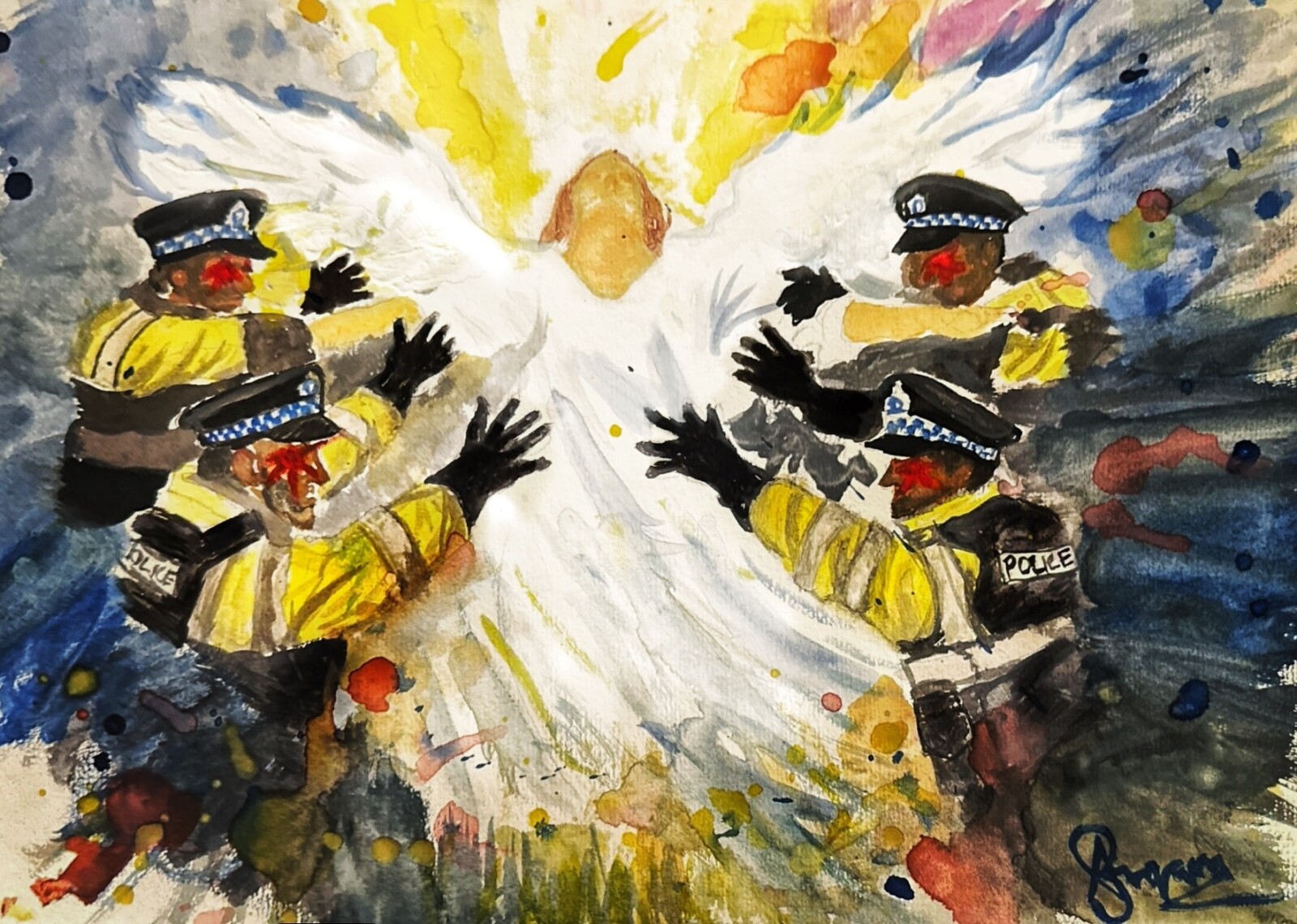
This watercolour painting is dedicated to a 45-year-old woman with bipolar disorder who was experiencing a severe manic episode with psychosis. During her episode, the police were called because she was perceived as uncontrollable. Multiple officers had to restrain her throughout the journey to the mental health hospital, and she was labelled as someone who has trouble with the police and as a difficult patient. From the outside, the scene appeared chaotic and resistant. However, when I later sat with her to take her history, the narrative shifted completely.
She described feeling as though she were an angel, standing with her arms outstretched. The voices she heard told her that the police officers were demons trying to capture her and take her away from her life and her family. In her reality, she was not being difficult. She was defending herself against what she genuinely believed was a terrifying and existential threat. Hearing her perspective profoundly changed the way I understood that event. It made me reflect on how quickly we can assign labels without fully appreciating the lived experience behind someone’s behaviour.
In the painting, I chose to depict the officers in bright yellow uniforms, immediately drawing the viewer’s eye to their physical presence and authority. Their dark gloves and firm grasp contrast with the central figure in white, symbolising her perception of herself as angelic and pure. The swirling whites and blues around her arms suggest both movement and transcendence, echoing her description of standing like an angel. The splashes of darker tones and abstract stains in the background represent chaos, confusion, and the fragmentation of reality that often accompanies psychosis. I intentionally avoided sharp rigid lines. Instead, I allowed the watercolours to bleed and blend unpredictably across the page. This reflects the fluid distorted boundaries between reality and delusion during a manic psychotic episode.
I chose watercolour as my medium because of its unpredictability and its capacity for both softness and intensity. Watercolours cannot be fully controlled. Once the pigment meets water, it spreads in ways that are sometimes unexpected. This mirrors the nature of mental illness, particularly mania with psychosis, where thoughts and perceptions can rapidly expand beyond control. At the same time, watercolour can create delicate luminous effects, seen in the white and yellow areas, which symbolise vulnerability and humanity beneath the behaviour.
The composition invites viewers to question their initial assumptions. At first glance, it may seem like a scene of restraint and disorder. But when viewed through her perspective, it becomes a story of fear, survival, and misunderstood reality. My message through this piece is that it is dangerously easy to label patients as difficult or troublesome, especially when law enforcement becomes involved. Yet behaviour does not occur in isolation. It is rooted in perception, belief, and lived experience. Given her context, believing she was being captured by demons, anyone would likely fight back. I know I would.
As healthcare professionals, we have a responsibility not only to manage risk and maintain safety but also to seek understanding. Taking the time to sit with her and truly listen transformed the narrative from one of confrontation to one of compassion. This painting is a reminder to me that behind every label is a story, and behind every difficult patient is a human being trying to survive their reality.
University of Sunderland, Medical School
0 Comments