
The Grip of Alcoholism
Jasmine Scott





However, one incident caused Jen to dramatically change her attitude and it was this sudden change which surprised me. Jen had passed out due to alcohol consumption and as a result was not able to feed her waiting children – the stark realization that drinking had not only impacted her ability to take care of her children, but also the thought of having caused them harm triggered her willingness to seek support. My encounter with Jen really made me consider ways in which we motivate patients, and the grip addiction can have on an individual’s life.
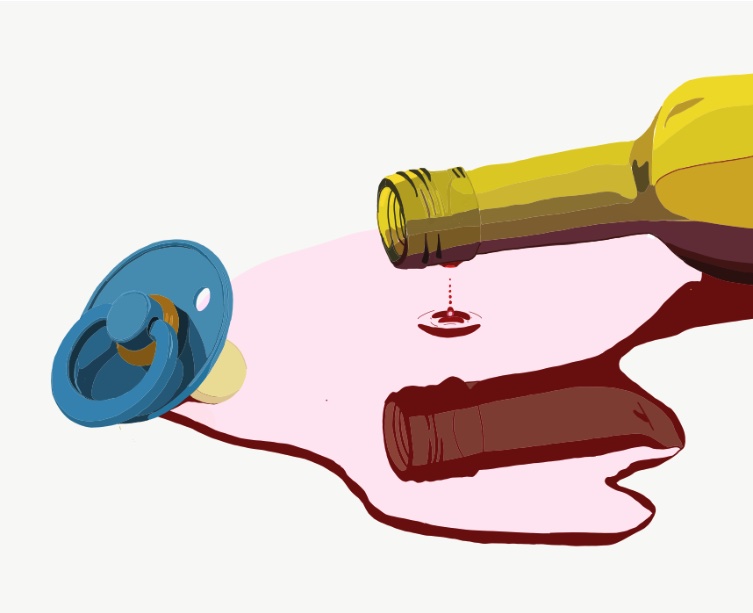
My creative piece shows a bottle of wine having been knocked over. The bottle represents Jen’s drinking addiction and the dummy – her children. This drawing shows the point in Jen’s life when her drinking could no longer work cohesively with her children, as the dummy, previously used as a stopper, is unable to contain her addition.
She came to reflect on her behaviour and its impact, symbolised in the reflection of the wine bottle in the spillage. Jen’s realisation was driven by her inability to continue suppressing her alcoholism; the spilt wine is indicative of her the severity of her addiction exposed for everyone to see.
I chose to present my creative piece as a digital drawing as I feel the clean and simple nature of the medium contrasts the disorder that comes with the alcohol addiction.
This encounter made me understand that helping patients to break destructive habits is not as simple as explaining the health consequences of their behaviour. The most influential skill is discovering a patient’s priorities and what is important to them, as this allows you as a doctor to steer the consultation towards that of change. While it can be frustrating to consult with individuals that have no desire to change their behaviour, it is important to continue to check in and offer support. You can never be sure when the willingness to try and change their behaviour may start, they will need support in doing this at the right time for them. This interaction will alter the way I consult with patients, and I will focus on building a rapport and discovering what priorities may increase the likelihood of behavioural change, rather than focussing solely on the health facts about their condition.
Creating this piece allowed me the chance to reflect on the consultations I have undertaken throughout the year and further consider my skills in supporting change, something that without this project, I would not have done.
Comments
Add legacy comments here
This piece of artwork really spoke to me as my family have fostered a little boy whose biological mother struggled with alcoholism. It was really difficult for us to see the first-hand impact of this on his development and how this will affect his life prospects. She really wanted to change and be able to provide for him but as a care-leaver herself who had had a really difficult childhood she didn’t have any good adult role models.
The placement of the dummy in the spilt alcohol to me represents how it’s difficult for there to be a separation between the parent’s alcoholism and the child’s upbringing. Even if the alcoholic parent tries to protect their child from this it is inevitable that it will affect the child in some way.
This piece of artwork is beautifully painted and tells a really important and under-represented story.
This piece immediately caught my eye due to the use of the three bright primary colours, its simplicity and its clear meaning. The description of the artwork illustrates what the artist intended the piece to represent but I don’t think it needed to due to how well the effects of alcoholism on children is shown through the design. I love how the dummy was originally the stopper but now it lies in the remains of the bottle. Also, the choice of medium to contrast the messiness of alcoholism. The whole piece is so clearly well thought out and the description is well written to tell the story of the mother and show that understanding each individual patient is so important to helping them.
I found that the piece was initially simplistic with striking colours but as I was more captivated by it the message was very clearly portrayed. The use of the dummy as the wine stopper and how it is no longer about to contain the wine in the bottle enhances the impact of the piece. It brings the conversation around alcoholism into focus and humanises the people involved. The deep red was a good choice as it highlights the dark side of recreational alcohol use and how it can leave a stain of the people it impacts. Additionally the reflection in the spilt wine represents the story around Jen and her sudden change as it symbolises self-reflection. moreover the dummy not only represents the child but signifies the tarnishing of the child’s innocence as it is covered in the wine, this nicely draws a focus on how alcohol use can have a deep impact on the child and how this may stay with them forever. The artwork clearly and effectively mirrors the story told and creates a more meaningful portrayal of the impacts alcohol abuse and addiction have on the people around. Jen story was deeply impactful and spoke a beautiful message through the visual aid of the piece.
This piece simply and clearly demonstrates the complex issue of alcoholism and how it affects people and their families. The artists portrayal of the spilt wine displays the loss of control that the parent felt they had over their alcoholism and the dummy being stained shows the lasting impact that the addiction will have on her children. The reflection of the wine glass symbolises her ability to self-reflect on her behaviour leading to the realisation that she needs help. This piece made me consider how people suffering with addictions may not be willing to change for themselves and the importance of building a rapport so they will be more open and responsive to advice.
I think this piece really showcases the connection between patient’s health behaviours and their lives outside of medical health, particularly with how the wine from the bottle (representing her alcohol addiction) links directly to the dummy (representing her children and her motherly duties). The colour of the wine being the same as blood, along with the reflection of the bottle being the same colour could symbolise how alcohol addiction has ‘blood on its hands’, and how it can so often be a cause of physical, mental and social harm. There is also the unsettling yet stark juxtaposition of a dummy and alcohol, and the reaction of the viewer to this juxtaposition just goes to show how these two worlds of addiction and raising a family should not collide.
This piece first stood out to me due to the bold, contrasting colours and its simplicity. The simplicity allows for the message to be conveyed starkly showing the impacts of alcoholism and in the patient’s scenario how one accident is all it takes for you to realise and quit your addiction. The wine spilt over onto the dummy powerfully represents how alcoholism can affect your loved one’s upbringing and your life without even intending for it to, like the spilt wine being accidental but leaving a big stain. Furthermore, the reflection of the bottle could further highlight how sudden scenarios like the patient’s can make you more aware of your problems; prompting the reconsideration of people’s decisions surrounding alcoholism. The artist makes you think about this, and consider how different patient’s respond to advice and understand that sometimes the change begins with themselves and looking at the impact it has on things that are important to them, rather than in a clinical setting
I found this piece to be extremely moving as I perceived it to represent the idea that those who struggle with alcoholism do not necessarily choose the life they lead but rather are born into it therefore finding it rather difficult to break that cycle. I view the spilled wine as representing blood due to its bright red colour and I feel like this highlights the negative impact alcoholism can have on an individuals health but also how it can impact those around them such as their children. The dummy being attached to the bottle highlights the idea that the individual is struggling to balance their parenting duties with their desire to drink and I believe the reflection of the bottle in the liquid could represent the guilt that the individual is feeling. The use of vibrant colours for the wine bottle compared to the more pastel colours used for the dummy can illustrate the disconnect between the parent and the child due to this barrier or it could represent how the individual views each aspect e.g. seeing the alcohol as an intense desire that they are drawn to and the dummy representing a calmness that their child makes them feel.
Before reading the story behind the piece, I already found it to be very interesting and it called to me. I wanted to find out more, and reading the story made me reflect on the effectiveness of certain doctor-patient relationships. Firstly, the artwork is incredibly well done, with clean lines but very clear depth. It clearly shows the morals of the story behind the painting, and it truly makes you think about not only how to deal with patients, but what your own priorities are.
This is quite a deep photo. It just goes to show how bad an alcohol problem Jen has as she even went as far as using a dummy as a stopper for the alcohol. When a dummy should really be used by a child it is instead used for alcohol, showing that alcohol has become as precious as a child to her.
This art piece really stood out to me because it was so smooth yet had a really complex meaning behind it even though it appears simple. I really like the bold contrasting colour of the dummy which emphasises how much the children were hiding the true addiction up untill a certain point. This for me really captures the whole story and is so easy to see within this piece.
I find this piece a very powerful example of the way that an alcohol addiction effects many parts of an individual’s life. The use of the dummy was particularly poignant as it emphasised how the alcohol dependency of the mother was directly harming her child. This whole piece caused me to think about a patient I met at the GP who had turned to alcohol to deal with grief and how this affected many other parts of his life negatively.
This piece stood out to me due to the contrasting nature of the colours. The two simple objects, which by themself mean completely different things but together tell a story of a child and a mother. This shows how alcoholism can slowly drip from affecting one life to the next. The proximity of the two objects shows how once the two may have been very close together but over time this space has a been stained by the red wine never to be removed. I think this is what the contrast between the white background and the red wine is meant to show, how alcoholism leaves a permanent mark upon all, no matter how hard you try the wine will always stain. I think the reflection is meant to show hope, as you can look back on your mistakes and decisions and then try to fix them.
This piece is an eye-catching and creative portrayal of alcoholism’s impact on Jen and her children’s life’s. Before reading the description, the piece clearly evoked a message of how alcohol can impact young children but after reading more i found the concept of the dummy finally falling out of the bottle fascinating and a very emotive portrayal of the relationship between alcoholism and her children. The simplicity of the art style shows the clarity of that moment for Jen with softer pastel colors evoking a more peaceful feeling maybe indicating the positivity and hope of her finally reaching out for help.
Your creative piece is a powerful visual metaphor illustrating the struggle between personal addiction and parental responsibility. The juxtaposition of the wine bottle and the pacifier visually emphasizes the clash between Jen’s role as a mother and her battle with addiction. By using digital art, you’ve created a clean, almost sterile presentation, which contrasts strikingly with the chaotic reality of alcoholism and the emotional turmoil it brings. This contrast reinforces the message that addiction is not immediately visible or “messy” on the surface, but its effects spill over, affecting everyone in its path.
Your reflection on how this experience can influence approaches to consulting with patients is insightful. Recognizing that helping patients confront and manage destructive behaviors requires understanding their values and motivations is crucial. Building rapport and aligning advice with what patients find meaningful can indeed foster a stronger foundation for change.
Your project not only showcases your artistic skills but also highlights an empathetic, patient-centered approach to medicine. This awareness of patients’ priorities as a gateway to fostering change will likely enhance your effectiveness as a healthcare provider. Thank you for sharing this thought-provoking piece and the reflections it inspired.
I was drawn to this piece as it shows how much a grip addiction to alcohol has and how hard it is to get out of the addiction. I was glad to hear about the patient’s awareness and how it highlighted that alcohol addiction does not only effect the individual but everyone around them.
Although I feel like I can’t contribute much more to what has already been commented I do still think it’s worthwhile to add why I felt such a draw to this particular image. The danger that alcoholism poses not only to the abuser, but those around them, is likely to be devastating. The image sharply and efficiently shows this to the viewer.
The reflection of the wine bottle in the spillage is my favorite part of this drawing. Looking inward to examine what we are doing, and why, can be an important part of change. In medicine it may lead to lifestyle choices that result in better health for people, and perhaps if this were a more common skill we would see vastly different behaviors in our communities. Maybe we wouldn’t make what is undeniably drug use a fairly socially acceptable pastime. Either way this artwork is interesting and I liked its message.
The piece is simple in nature but gets across its point immediately from first glance, while still having the message be shown the a metaphorical artwork. It highlights how although alcoholism is primarily seen and viewed as a purely self destructive addiction, it really affects those close to you, and especially those dependent on you far more than is widely considered.
This work initially caught my eye due to having a dummy and a bottle in the same image – I felt that this piece would have an interesting background. It shows the effect that alcoholism has on those around you, as well as just on yourself, with the extra factor of the dummy showing innocence and dependence. Additionally, as discussed in the comments, it also shows how it is important to consider what is important to the patient, as well as just the issue itself.
The artwork is powerful because of the attention brought to the alcohol and the chaotic connotations of a spilled bottle. The simplistic style and use of such little but bright colours highlights the splilled alcohol and juxtaposes it with the baby’s dummy where seeing these two objects in contact would incite alarm in a viewer. It may warm patients who potentially struggle with alcohol use about the dangers to the people around them, especially those as innocent as a baby.
This drawing caught my eye through the use of bold colours and the emotional impact of the wine seeping onto the dummy, highlighting the impact of alcoholism on more than just one’s own health. Both the reflection of the bottle in the wine and the wine droplet connecting the bottle and spillage, mirrored the connection Jen made between her alcoholism and its effect on her parenting. I was moved by the drawing’s depiction of Jen facing her addiction and seeking help.
This wonderful artwork demonstrates a struggle faced by many: addiction vs priorities. I was particularly struck by the continuous dripping of the red wine which symbolises Jen’s gradual release from addiction and as she becomes more aware of how alcoholism is affecting her children’s lives. She is becoming more and more open about her addiction. Another way to interpret this is by realising that the pool of wine is still connected to the bottle which almost creates somewhat of a juxtaposition as this addiction is still part of her life and it will be difficult to move on from. Since some wine will always remain in this bottle, it creates the image that the addiction will never completely leave Jen and that alcoholism will haunt always haunt her. One final personal interpretation is the dummy lying in the pool of wine which could suggest that the effects of alcohol addiction endured by the children will not be forgotten and reminiscence of this has had a permanent damage on the kids. The only way this can be undone is if someone actively cleans up the wine symbolising these memories being wiped. Yet even then, there will eternally be stains. The simplicities of this piece contrast with the small intricacies- every detail contributes towards a powerful, layered portrayal of loss, awareness and the intense journey towards recovery.
This artwork really stood out to me because of how simply yet powerfully it captures the conflict between addiction and responsibility. The image of a baby’s dummy beside a spilled wine bottle immediately drew my attention — it made me think about the tension between care and neglect, and how addiction can slowly erode someone’s ability to fulfil their most important roles.
What I found most striking was how the dummy, which could once have acted as a stopper, now lies useless beside the bottle. It felt symbolic of how Jen’s children were no longer able to “hold back” her drinking, and how her addiction had reached a point where it could no longer coexist with her responsibilities as a mother. The reflection of the bottle in the spilt wine adds another layer — as though Jen is finally being forced to confront the reality of her situation, seeing herself reflected in the damage caused.
This piece made me reflect on how motivation to change often comes from deeply personal moments rather than medical advice alone. It reminded me that when supporting patients with addictions, it’s important to understand what truly matters to them — in Jen’s case, her children — because that can be the key to initiating recovery.
The bright primary colours of this art work draw attention to Jen’s harsh struggles with alcoholism. The wines contents spilling onto the dummy shows how her alcoholism is affecting her care of children such as when she couldn’t feed them. The use of digital art shows the harsh reality of alcoholism and its impact but contrasts the messy reality of alcoholism. Overall this piece invokes the emotions of a struggle of balancing family alongside an addiction and the difficulties it took Jen to reach out for help.
The arts premise of alcoholism overreaching into the private life of those around them particularly their children is really well conveyed.
The artistry of the red wine spilling from the bottle onto the babies dummy promotes thoughts of the wine, a symbol of the addiction, reaching out to corrupt the dummy a symbol of childlike innocence.
The notion the dummy was once a stopper as the artist describes though not my first impression adds depth to the art. The dummy being the limiting variable preventing the wine escaping from the bottle, a potential metaphor for her not recognising her own issues as described in the statement, was very powerful for understanding how difficult it may be to recognise that you have an issue.
The choice to not include imagery of people rather using objects in an art piece about this topic really allows for the observer to think about what it may convey and to take the most important message for them from it.
Summarising, I think it’s a really unique piece that uses strong imagery to give depth allowing for subtly different interpretations between viewers. The art itself is really well done and sharp,
The yellow bottle’s contrast with the shadow of alcohol it casts strikes me as a poignant reminder of the suffering and melancholy alcoholism inflicts on a person. More stark is the chained dummy, which reflects the widespread effect alcohol has on the addict’s loved ones, while the lack of pictures or people also makes the simple image more powerful. Alcoholism is such a widespread but neglected problem in our society, and this artwork depicts the struggle many face on the road to their recovery