





on show in this place
backs against the wall
stiff upper lip
don’t let your emotions
start to slip
if the floodgates start to open
you know they won’t stop
we must stick together
before we go over the top
let’s talk about the weather
it really looks like a nice day
but don’t look too far ahead
storm clouds could be gathering
inside your head
I can’t stand next to you or you or you
and invade your space
the subject you really want to talk about
it is written all over your face
all the words fly around
we are just wasting time
but that’s just what they are
so, we can slowly move up
to the front line
when our names are called
no words left to say
we are going over the top
to find out
if it really is a sunny day
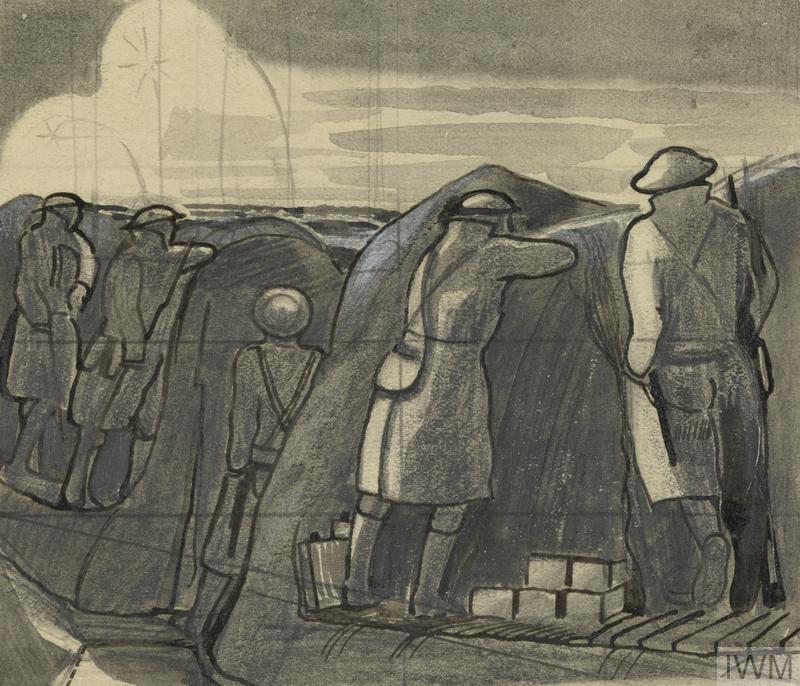
© IWM Art.IWM ART 3920
The waiting room or the outpatients in a cancer hospital are not like any other hospital. There is only one reason people are there, just saying the word is enough to frighten most people, but attending a cancer hospital over months and years can really wear you down. I wrote this poem hoping to convey how hard it can be for people to show how they really feel, in a room filled with fear, anxiety, stress, hopes, doubts and wishes, while waiting for good news or bad.
Arts contributor to the Living Alone with Cancer Experience research led by Cardiff University School of Healthcare 2016-2018.
Mal was also a patient and public involvement advisor throughout this project – funded by Tenovus Cancer Care:
http://blogs.cardiff.ac.uk/cancerservicesresearch/art/
I find this piece very moving and thought provoking. The writer really manages to encapsulate the stress, anxiety and worry about whether it will be good or bad news whilst in the waiting room of a cancer hospital through their likening of the experience of waiting being like that of soldiers on the frontline. I really like this comparison because I think it expresses the anticipation, fear, nerves and discomfort the patient is going through in an effective way. They are in unknown territory, preparing to go over the front line and ready to fight whatever is coming their way. They put on a brave face, scared to show emotion because if the “floodgates” open they fear they may never stop. The line “we must stick together” to me seems like they also want to do this because they want to be strong for others in the waiting room as well.
This piece was quite thought provoking to me and I find that this author was able to draw on his past experiences at a cancer waiting room to encapsulate the feelings everyone would have felt if they were in one. Throughout the poem, they compared waiting in at the cancer hospital waiting room to climbing up a hill with phrases such as “before we go over the top” etc. Therefore you could draw parallels from waiting in a cancer hospital to a long arduous journey up a hill or mountain and only at the summit/peak would you get to know what lies in front of you. I believe the first phrase “it is hard to find love on show in the place” encapsulates how distressed a person would be in the waiting room and shines a spotlight on to the lack of warmth/reassurance they would experience. The author also portrays this sense of impending doom someone would feel with the phrase but “don’t look too far ahead storm clouds could be gathering” this just goes to show that everyone is afraid of moving up in the line and the thought of their name being called out would cause them a lot of stress. Not only do they compare the waiting room to climbing up a mountain but they also compare it to a or war or more specifically soldiers in a war. This is further reinforced with the picture chosen, by the author, to accompany the poem. The author implies that everyone there has put on a brave face so that the “floodgates” don’t open and with the phrase “we must stick together” everyone seems to be bound together at this one moment in time, possibly giving people a tiny glimpse of courage knowing that they are not alone. The picture chosen has very little bright colours involved, highlighting how the people were only focusing on one thought, in the waiting room. The 5 soldiers in the picture also seem to be looking out onto the vast horizons and sky. Possibly adding to the fact that cancer is a massive disease to conquer with so few people.
Overall I think the author has done a great job of showing us the stress and discomfort one would face in a cancer hospital waiting room
I love the fact that the author is able to emphasise their unique comparative experience of being at the front line in the war vs waiting in the oncology ward for potentially bad news. The imagery from both scenarios really come together, and the idea that all the patients in the ward, no matter their differences, are united in their fear at this particular moment. The metaphor of sunny blue skies representing the ‘all-clear’ creates the idea of freedom and happiness – they’re not chained to a difficult diagnosis. The short lines create a sense of tension and fear, and help control the pacing of the poem – this almost represents what patients feel when waiting for a decision, whereby time both slows down and speeds up: it’s stilted and off. It finishes with no clear ending of what happens, highlighting how for each patient it is different and individual, and you don’t know until you’re in that room.
I found this interpretation of a cancer patient awaiting news very thought provoking. While I have often consider how awful some oncology consultations may be, this imagery made me appreciate how traumatic the hour or two waiting for the 10 minute appointment also is. Likening going into the consultation to going over the top in a war shows the lack of control that patient feels in that moment. It may suggest a part of them doesn’t even want to go in, even though you may imagine patients would be keen for updates on their condition. Comparing the good or bad news to weather shows the position of power the doctor delivering the news to the patient is in – compared to the power of nature/god.
We are all familiar with the mental turmoil that waiting for battle had and has on soldiers (especially present in the many films and series produced on the first and second world wars), and I find this comparison between a cancer waiting room and the trenches to be incredibly poignant. The looming sense of an unknown, a waiting list ticking down towards you turn is captured very clearly in the second stanza, while the general references to a stiff-upper lip and the weather add a very clever cultural element to this – the traditional British facade of pretending everything’s fine, and avoiding the topic all together. Overall the extended metaphor of war that accompanies the oncology narrative creates an exceptionally moving piece, and I feel it does well to explain the complexity of emotions in a way the reader might better be able to understand.
This piece captured my attention through its comparative nature, conveying the similarities between waiting in the trenches at war and in a cancer waiting room. The emotions felt by both soldiers and patients, knowing there is only two outcomes (life or death), signifies to me just how terrifying being a patient in that waiting room must be as each person’s fate is determined before them.
Particularly with oncology, it can be a long process to get to that point of finally finding out the results, there is often a mixture of wanting to find out but also knowing your world could be about to change, this is similar to the anticipation felt by soldiers as they ‘slowly move up the front line’.
I think it also highlights the isolating aspects of being an oncology patient, mentioning that the soldiers can’t talk about the ‘subject they really want to talk about’ and making sure they ‘don’t let their emotions slip’ adds another dimension to the mental torment that a patient will already be feeling, while also showing the lack of reassurance many patients receive when put in this ‘taboo’ situation.
The metaphor of comparing the results to the weather is effective as it emphasises that the outcome is something that both patient nor soldier can control, as well as the uncertainty of cancer, despite it looking like a ‘nice day’, ‘storm clouds’ can quickly gather (can come back at any moment even once you think you are free).
I think comparing a cancer hospital to a battlefield is a very insightful way to confront a difficult topic. By describing it in this way, the reader gets a sense of anxiety and panic and can begin to understand from the patients perspective how it must feel going time and time again, waiting nervously to be told something that can change the course of their life. The mentions of the weather are a potent reminder that the patient’s reality can change in an instant, leaving them in an unfamiliar state they feel completely unprepared for. We can also get a sense of the isolation that can be felt by patients when they can’t talk about ‘the subject you really want to talk about’ as they may feel that no one understands what they are going through.
This poem shows really well what it feels like to wait in a cancer hospital, where people are scared but trying to stay strong. I like how it compares the experience to going into battle and how it shows people hiding their true feelings behind small talk. It’s emotional and honest, and it makes you think about how much courage it takes to face such moments. It also captures the sense of unity and quiet understanding among people who are all waiting for news, good or bad. The poem leaves a lasting impression and helps the reader feel empathy for everyone in that room, showing the strength it takes to keep going when everything feels uncertain.