
Skin conditions: diagnostic inequalities
Julia Rystaw and Danielle Johal
Mixed-media





In our project we focused on the difference in presentation of certain skin conditions on different skin tones. We felt that racial inequalities in healthcare are widely unacknowledged and must be highlighted to all healthcare professionals as well as to the public in order to improve awareness. The focus of our research was on the disparity in the number of medical images of skin conditions on light and dark skin tones. In our initial research, we saw a shocking statistic that only 4.5% of the 4146 pictures in widely recognised medical textbooks, including Gray’s Anatomy for students, had dark skin tones represented (Louie and Wilkes, 2018). This highlighted the large inequality in the way healthcare professionals learn and therefore diagnose and treat individuals, causing a disparity in the treatment of individuals. Missed and incorrect diagnoses due to underrepresentation, increasing patient dissatisfaction and decreasing quality of care.
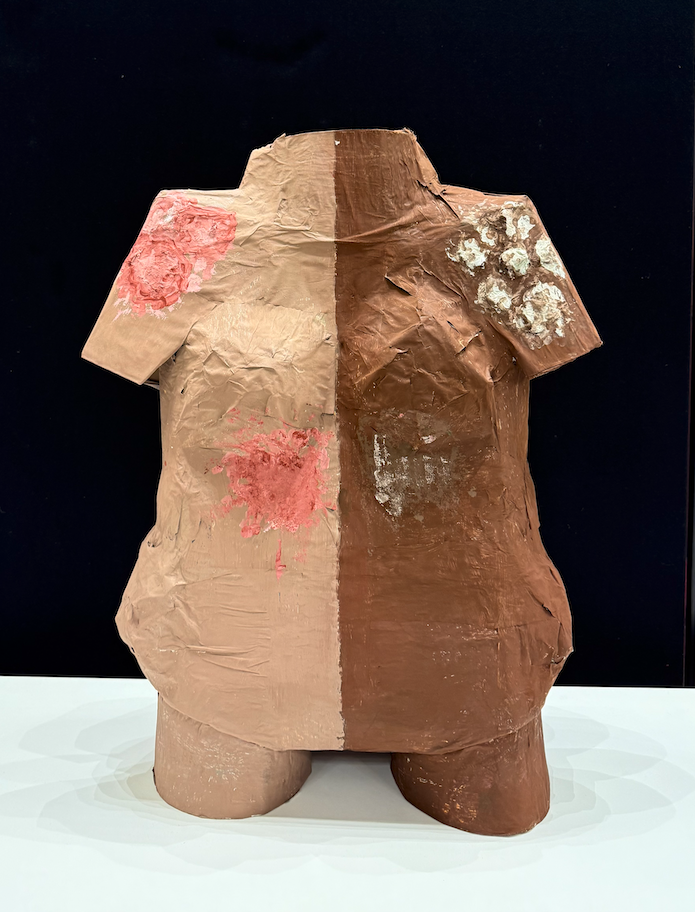
We created a papier-mâché sculpture showing the difference in presentation of eczema (below the breasts), psoriasis (front of the shoulders) and Lyme disease (back of the shoulders) on light and dark skin tones. We acknowledge that there is a wide range of presentations on a variety of skin tones but chose to focus on two that demonstrated the contrast of presentations on different skin tones and to highlight the importance of this message.
Our sculpture demonstrates the need to address this inequality. To bridge the gap in misdiagnosis we propose that medical textbooks and teaching material should show a range of conditions on a spectrum of skin colours. This would ensure an improvement in diagnosis but would also enable healthcare professionals to provide adequate care for all patients.
This artwork is also intended to illustrate how misdiagnosis can truly impact the patient themselves, how patients can feel misheard or ignored as their symptoms and experiences are mislabelled as another ailment. By bringing forward this project we aim to encourage medical professionals to develop educational materials and improve clinical knowledge.
Louie, P. and Wilkes, R. (2018). Representations of race and skin tone in medical textbook imagery. Social Science & Medicine, [online] 202(202), pp.38–42. doi:https://doi.org/10.1016/j.socscimed.2018.02.023
Year One, This work was exhibited at the Foundations of Medicine Conference, December 2024
Dear Julia and Danielle,
I have really enjoyed reading about and viewing your piece. To me, this sculpture powerfully highlights how the underrepresentation of darker skin tones in medication adversely affects health outcomes and further perpetuates diagnostic inequalities. By showing the various skin conditions on contrasting skin tones, your piece compels viewers to confront systemic bias. This piece reinforces the idea that equity in healthcare must begin at the root – with how we are taught to see and recognise disease.
Thank you,
Erin Bruce
This is a really insightful piece that highlights the extent of healthcare inequalities and how this can lead to dangerous outcomes for patients – misdiagnosis or no diagnosis at all. I like that you have put the two differing disease presentations next to each other so we can see the contrast in how these skin conditions look on different skin tones. I also like that multiple types of skin condition have been represented, demonstrating the large-scale impact of underrepresentation of darker skin tones in medical teaching.
The sculpture shows a torso divided down the middle with two contrasting skin tones – one light and one dark. Different skin conditions are shown on the body, such as eczema, Lyme disease and psoriasis. I like that you have used red and white paint on the torso to demonstrate how these conditions can vary on different skin tones. By doing this, you have shown how medical education is typically catered towards lighter skin, leading to under-representation and health inequalities. I find it particularly interesting how the sculpture demonstrates two halves of the same body, but they’re treated and represented unequally.