
White Walls, Dark Truths
Laila Khan





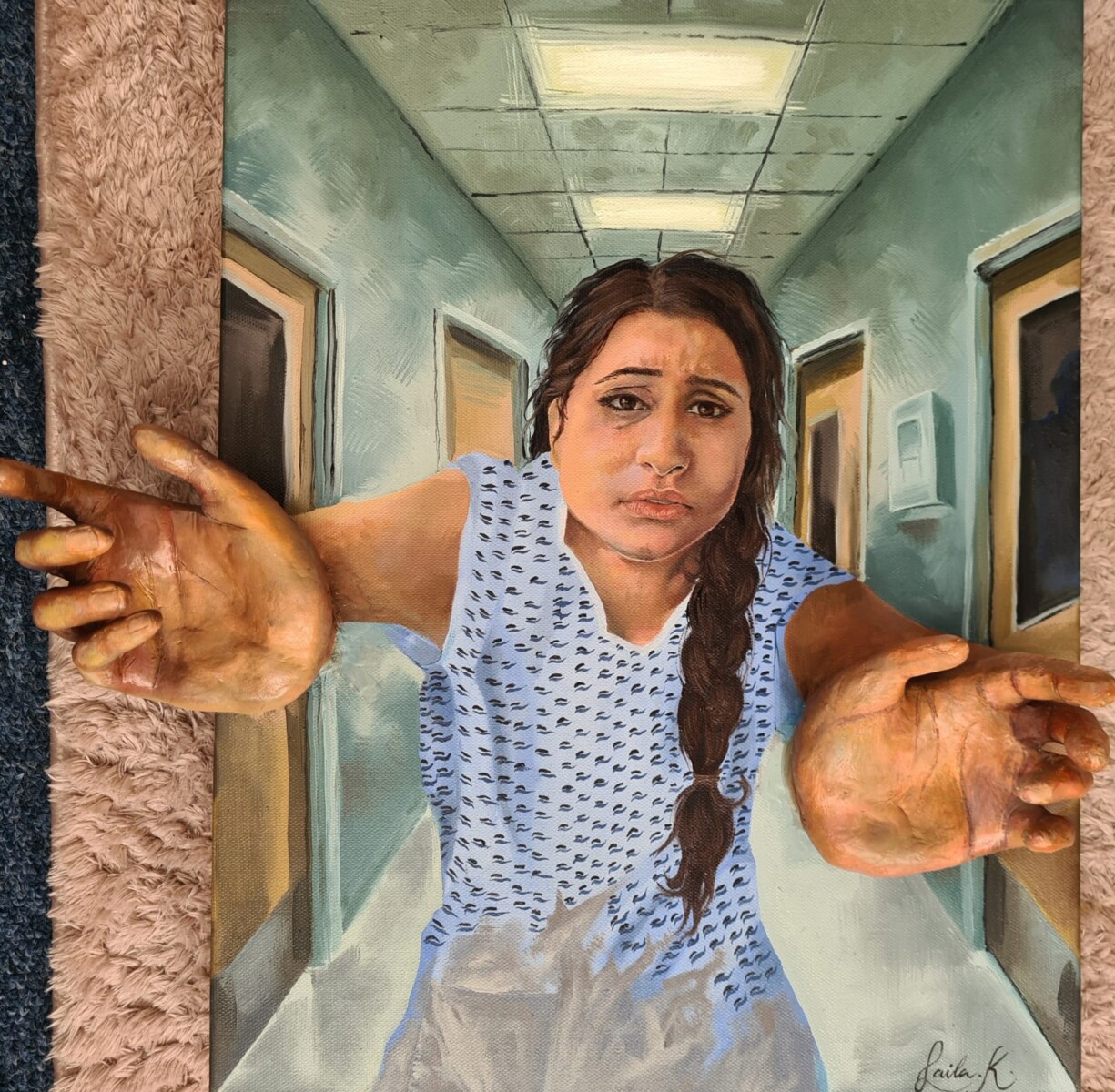
Set in an ambiguous hospital, this painting shows a distressed South Asian woman caught in the endless corridors of a supposed sanctuary turned nightmare. Her expression is haunted and pleading, reaching out to the viewer with 3D hands as if begging to be pulled from her surroundings. Her gown—both a patient’s gown and a nod to medical staff scrubs in its grey tones—symbolizes more than clothing: it reflects the loss of autonomy, hope, and identity, the emotional drain of institutional walls that offer no true comfort.
This piece explores the dark truths behind many institutions, healthcare ones being no exception. Abuse—physical, sexual, and emotional—runs rampant in hospitals worldwide, between patients, staff, and across hierarchies. While anyone can be a victim, women, particularly those from ethnic minority backgrounds, face higher risks. The corridors’ teal hues are drawn from personal memories of hospitals abroad—spaces often under-regulated, neglected, and far from healing, where fear is the norm. In such environments, abuse often goes unreported, shrouded in shame, institutional silence, and power imbalances.
The painted figure is deliberately vague – she has no clear physical wounds, seemingly mobile and healthy, yet dishevelled from endless nights in a loud, distressing environment. She may be a psychiatric patient, a group especially vulnerable to abuse and disbelief, especially in some areas abroad where there is still a large stigma around mental health. Her presence raises urgent questions about how hospital environments can worsen mental health, rather than nurture it. As someone from an ethnic minority background, I focused my piece and research on South Asia and Africa, where personally I have heard accounts of mistreatment and of families withdrawing treatment plans for loved ones due to the high risk of sexual assault in inpatient care. Yet even in the West, sexual abuse is widespread yet underreported. In the UK alone, over 6,500 cases of sexual assault were recorded in hospitals in just under four years, with only 4.1% resulting in charges. A 2021 UK CQC report revealed that nearly half of female mental health inpatients had experienced sexual harassment or abuse during admission.
Globally, in places like Uganda and Kenya, studies have documented the frequent silencing of victims, with reports often dismissed or left undocumented. In India, maternity wards have revealed routine verbal and physical abuse, with emotional trauma negatively impacting maternal and newborn health. These abuses are exacerbated for women facing structural barriers: poverty, illiteracy, lack of financial independence, rural living, or restricted media access—factors more prevalent in developing nations steeped in misogyny and traditional gender roles.
But the issue is not confined to patients. Female healthcare workers, even as the field evolves toward gender equality, still face stereotyping about inferiority. Many are victims of sexual misconduct, often from colleagues or patients. A recent report revealed 63% of female surgeons had experienced harassment from a colleague, and 30% had been sexually assaulted. So, if one takes this figure to also represent these female practitioners, the distressed expression is equally transferred – they cannot express their words for fear of being unheard, judged, and unable to speak out without professional consequences – they are just as trapped.
The hospital, then, becomes a character in itself—unwelcoming, even dangerous. Whether or not this woman has been directly abused, her mental state is clearly deteriorating. She is trying to escape a place meant to heal, but which fails to provide the care, security, and empathy she so desperately needs. The GMC states guidelines for patients and staff on sexual misconduct and how to identify your rights. Doctors hold a high position of trust that can be abused, and this imbalance of power should be stabilized by clear communication and trust between patients and their doctors. Despite several guidelines being in place, NHS trusts, just as other hospitals around the world, are failing to protect their patients and staff. Globally, women who speak out about their experiences often do not have their stories recorded and no further action is taken. This work calls attention to the urgent need for reform, protection, and humanity within healthcare systems—especially for women suffering in silence.
Laila Khan, Critical Medical Humanities Workshops, Year 2, Bristol 2025
Pradhan, M.R. and De, P. (2025). Women’s healthcare access: assessing the household, logistic and facility-level barriers in India. BMC health services research, [online] 25(1), p.323.
https://bmchealthservres.biomedcentral.com/articles/10.1186/s12913-025-12463-9
Clemens, V., Brähler, E. and Fegert, J.M. (2021). #patientstoo – Professional sexual misconduct by healthcare professionals towards patients: a representative study. Epidemiology and Psychiatric Sciences, [online] 30(e50).
https://joghep.scholasticahq.com/article/117357-dignified-motherhood-women-experiences-of-abusive-treatment-and-condemned-care-during-childbirth-in-the-health-facilities-of-urban-india
British Medical Association (2024). Eliminating violence against women and girls. [online] The British Medical Association is the trade union and professional body for doctors in the UK. Available at: https://www.bma.org.uk/news-and-opinion/eliminating-violence-against-women-and-girls.
Reading.ac.uk. (2023). 6500 hospital sexual assaults in four years according to new report – University of Reading. [online] Available at: https://www.reading.ac.uk/news/2023/Research-News/6500-hospital-sexual-assaults-in-four-years-according-to-new-report.
Global Press Journal. (2023). Global Press Journal. [online] Available at: https://globalpressjournal.com/africa/uganda/inside-ugandas-mental-hospitals-women-face-additional-trauma-sexual-assault
Kuria, M.W., Omondi, L., Olando, Y., Makenyengo, M. and Bukusi, D. (2013). Is sexual abuse a part of war? A 4-year retrospective study on cases of sexual abuse at the Kenyatta National Hospital, Kenya. Journal of Public Health in Africa, 4(1), p.5.
https://pmc.ncbi.nlm.nih.gov/articles/PMC5345424/
Hassan, M., Awosan, K.J., Panti, A.A., Nasir, S., Tunau, K., Umar, A.G., Shehu, C.E., Ukwu, A.E. and Sulaiman, B. (2016). Prevalence and pattern of sexual assault in Usmanu Danfodiyo University Teaching Hospital, Sokoto, Nigeria. Pan African Medical Journal, 24.
https://pubmed.ncbi.nlm.nih.gov/28154687/
Laila Khan, Creative Medical Humanities workshops, Year 2, Bristol Medical School
This work was later featured in the UoB intercalated B.A. in Medical Humanities summer arts exhibition Threading the Needle: Unravelling the Histories of Women in Medicine (website link for this curation coming shortly)
Comments
Add legacy comments here
1 Comment
Submit a Comment
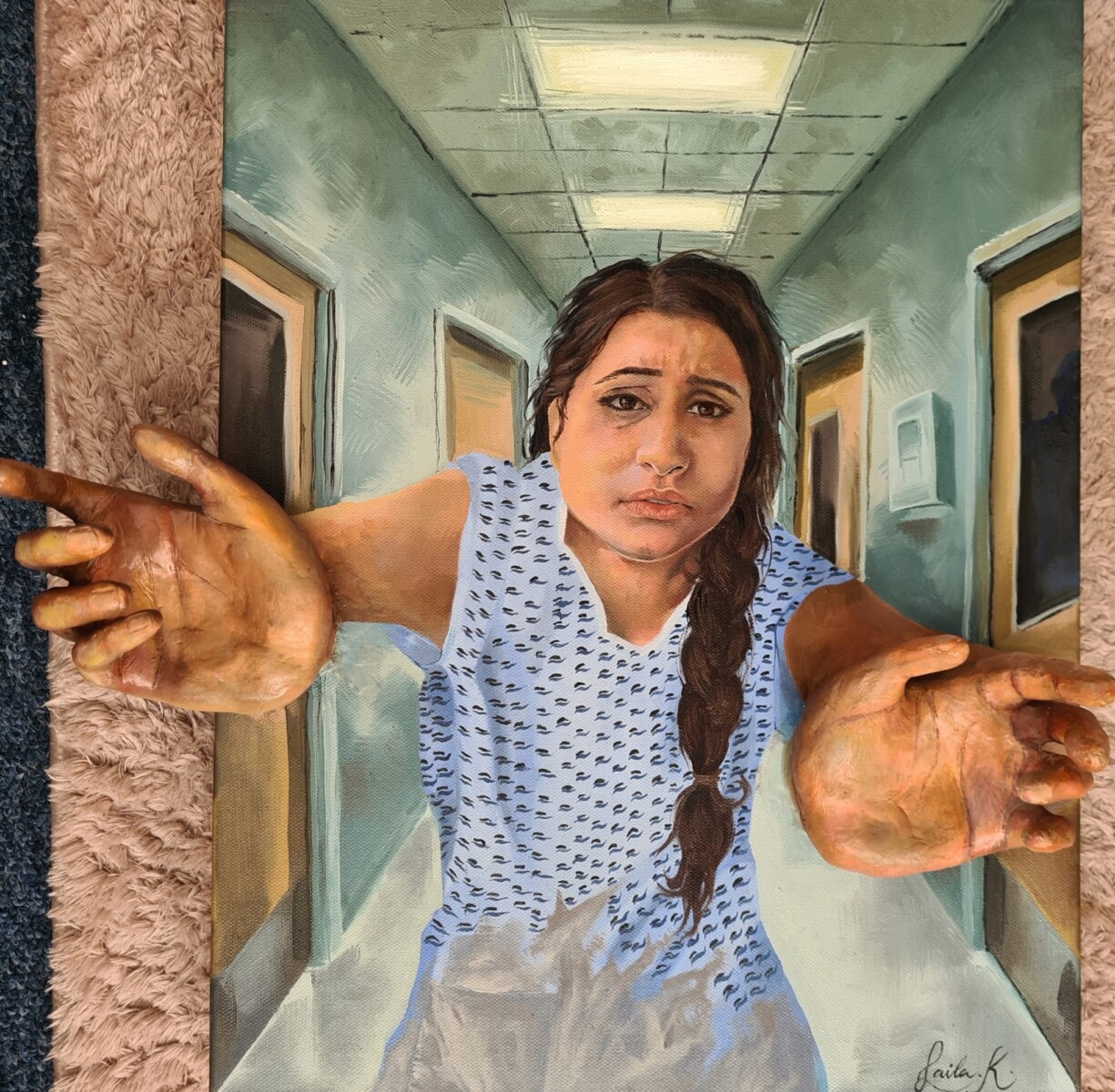
I found this to be an exceptionally powerful piece, the realistic hands reaching out of the canvas really forces you to resonate and feel for the patient despite not seeing any physical wounds. You get a sense of worry even before reading the additional information. The topic chosen is such an important one to share as many victims remain silenced, which you can see in the artwork because of how expressive her facial expression is, showing how tired and lost she is.