
Looking Beyond Normal
Alice Zhang
Painting





During my ECC placement in a cardiology ward, I met a lovely woman in her 40’s who had been admitted with hyopkalaemia after starting a new non-potassium sparing diuretic for her biventricular heart failure. As I was listening to her history, I learned that a few years earlier she had suffered from a heart attack that presented with epigastric discomfort, with lack of chest pain. Due to having a history of a gallbladder problem, her doctors pointed the pain towards that and dismissed her. It was only after seeing a clinician for the third time when it was discovered that she had was having a heart attack. By then her heart had been left irreversibly damaged, largely affecting her life now.
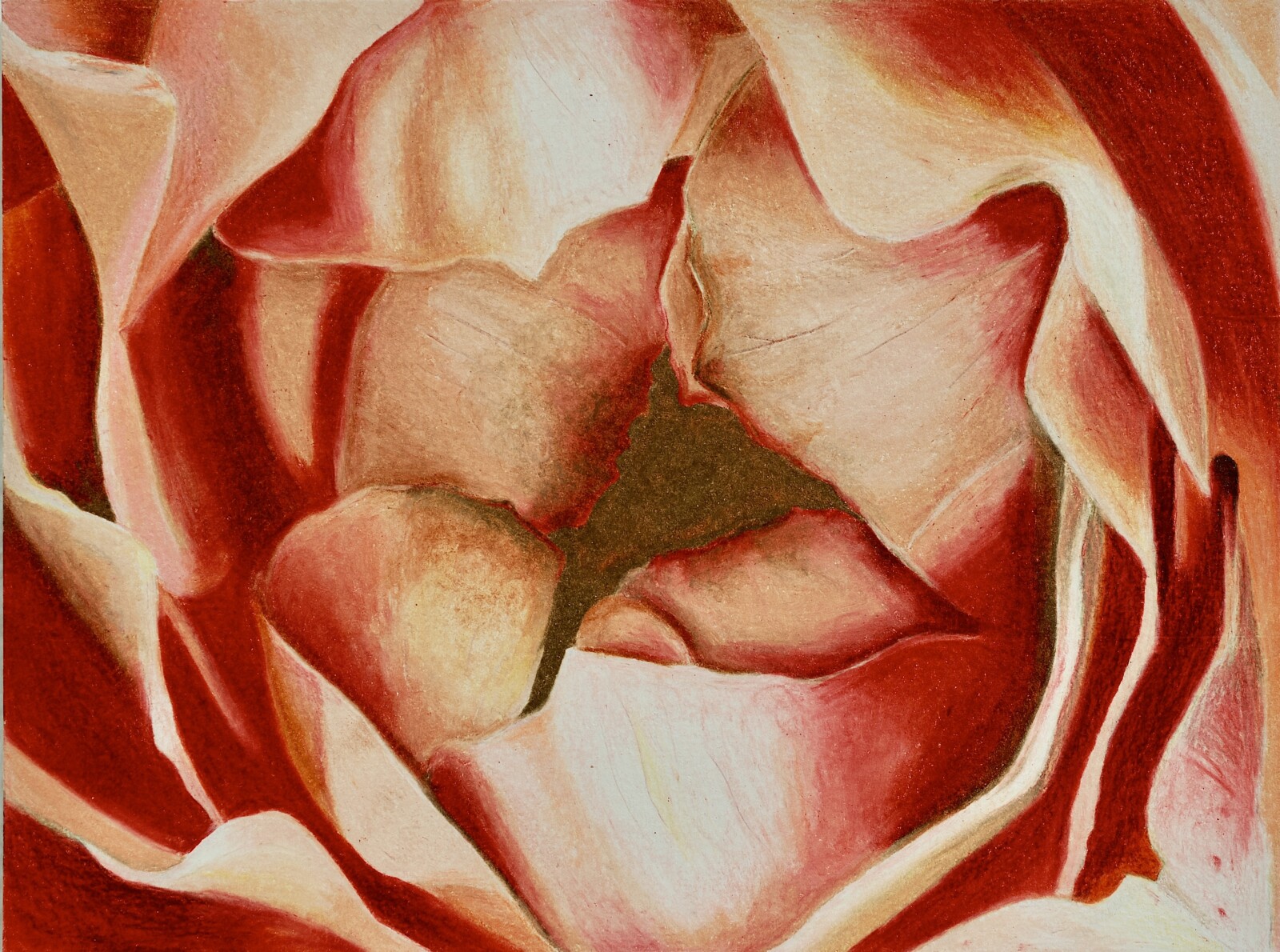
For my artwork, I chose to use the image of a blooming flower with a withering core. As time moves forward, the flower blooms and the disease progresses unrecognised, underneath. Only when the layers are peeled back one by one does this become more apparent but by this time the damage is irreversible. This imagery reflects the story of this woman, whose condition had gone unrecognised for too long, leading to lifelong damage to her heart and her way of life.
When you think of ‘left-sided chest pain radiating to the arm and jaw’, most would immediately imagine a heart attack. What is less recognised-even in the medical field as evidenced by her story-is that women often present differently to what is considered ‘normal’ with symptoms such as nausea or vomiting, epigastric discomfort, back pain or dizziness. Whilst men are more likely to suffer from a heart attack, women are twice as likely to die from one which could be attributed to a lack of awareness of women’s presentation of heart attacks, leading to a delayed diagnosis where time is crucial. This then led me to think where this idea of ‘normal’ came from.
Like the flower, there are also layers of complexity to this issue. This stems from the historic research of understanding human health by using the male body as the default, leading to incomplete understanding of women’s health. Even though now we understand that this one-size fits all approach is flawed, the ideas based on skewed historic research have stayed and will have an effect on the patients we will encounter.
Alice Zang, Effective Consulting, Year Two, Commended for the Annual EC2 Creative Prize, 2024/2025
This work was later featured in the UoB intercalated B.A. in Medical Humanities summer arts exhibition Threading the Needle: Unravelling the Histories of Women in Medicine (website link for this curation coming shortly)
This piece really caught my eye – the pencil lines and shading work really well together and I love the colour choices. The subject matter and composition decisions so that the flower fills the whole page with no background really reminded me of Georgia O’Keefe, one of my favourite artists. When I read the description and started to understand the meaning behind the artwork I was really moved. The way that the artist represented the patients permanent damage as a withering core with petals still trying to bloom around it and not become infected is really powerful and so effective. The artwork brings to light such an important topic in Women’s Health and the fact that we are still becoming aware of how conditions present themselves differently depending on the patients’ sex is both reassuring and also dumfounding, and I think the artist captured this really well with the art piece and description. I hope that more people see this artwork and discover the poignant meaning behind it like I did.
I was drawn to the detail and deep contrasts between the bold colours in this painting. I think the intricacy of this piece is really effective in portraying the complex themes which inspired it – I particularly appreciate how many petals reflect many layers to the issue of gender bias within medicine. The idea of the flower being damaged on the inside in my opinion reflects really well the severe effect of a diagnosis being missed or condition ignored. Although it is not immediately visible, it has a profound and long-lasting effect on the patient. I think the painting overall encourages a much needed conversation around gender inequality in healthcare and the importance of education around differing manifestations of disease in men and women. I was really intrigued by the artists description of the problems which arise around ‘normal’ symptoms, and I think using the flower as a representation of women’s health concerns often being dismissed is really effective, especially as it is a typically feminine symbol. I think the painting and the description behind it is very relevant to medical practice today and overall a really thought provoking piece.