
The Weight of Shared Memories
Anonymous





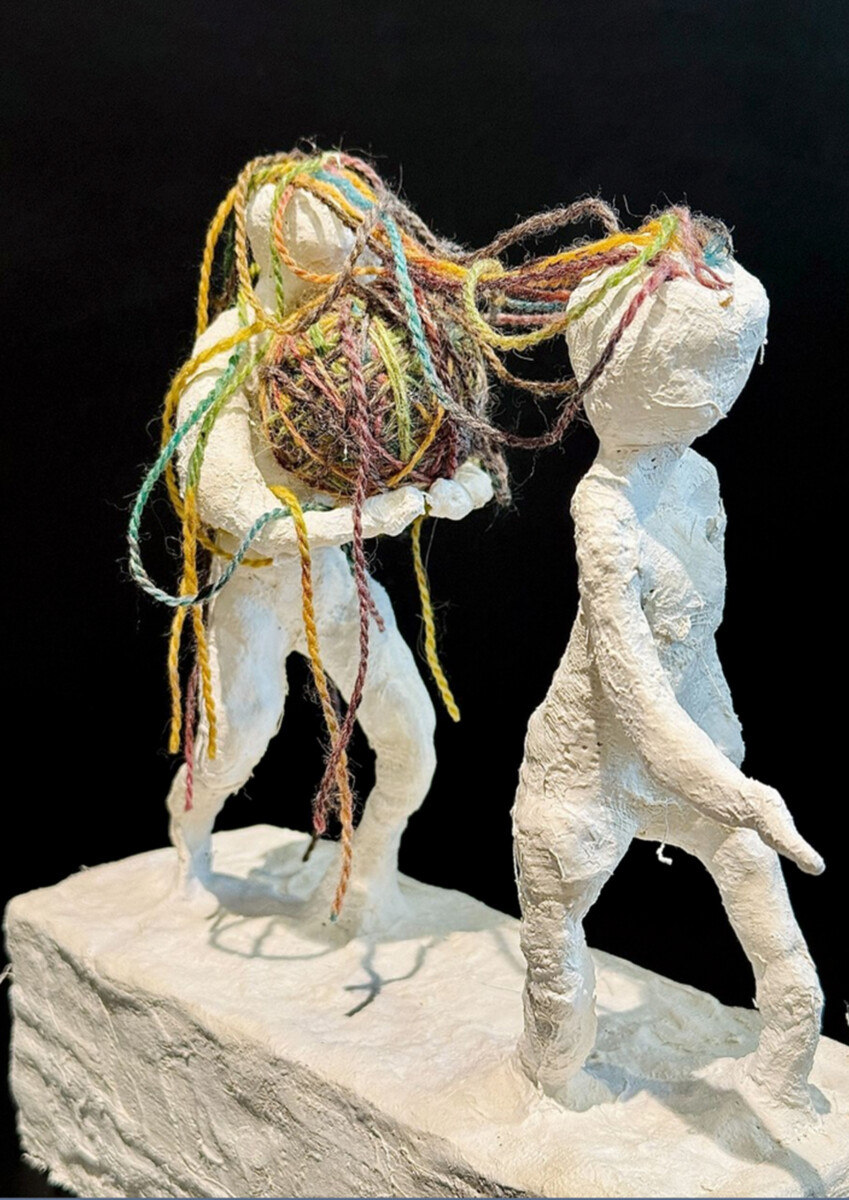
This art piece reflects my experiences on the frailty assessment unit, where I witnessed the profound impact of dementia on patients and their families. What struck me most was seeing caregivers’ exhaustion and emotional strain as they navigated their new roles while processing complex feelings of grief, loneliness, and guilt.
My model features two figures connected by coloured strings representing shared memories. As one partner loses their memory to dementia, the other becomes the sole keeper of their shared history—creating an uneven emotional burden. These strings symbolise both connection and constraint; they bind the couple together while representing the growing weight of responsibility on the caring partner.
I crafted this piece using plaster bandage, which hardens over time like memories that become fixed in one partner’s mind while fading from the others. The white, clinical material evokes medical settings that often accompany dementia care.
The three-dimensional format allows viewers to observe this relationship from multiple perspectives, hopefully bringing clarity to those experiencing similar situations. My intention is to honour the dedication of caregiving partners who carry not just their own memories, but become custodians of their loved one’s fading past—preserving first dates, wedding days, family celebrations, and quiet moments that might otherwise be lost forever.
This piece of art made me reflect on my experience with patients that had neurodegenerative disorders. The partner takes on the burden of a shared past that the other partner has no memory of, making it emotionally distressing for both of them. The partner with dementia is moving forwards, while the partner is left behind to pick up the pieces of their relationship. The lack of support from anyone else is also evident in this artwork, as often only the partner with dementia is ‘looked after’, while there is no help for the other partner, left to watch the person they love disappear slowly and painfully over time. The decision to use white plaster as a base gives a formless appearance to both partners – underlying the fact that this can happen to anyone. In my opinion, this piece of artwork is a poignant reminder of the challenges and difficulties that caregiving partners face everyday, and the deeper sense of loss that accompanies it.
As someone who has been volunteering in a care home for a number of years, I have constantly seen the profound effect of dementia on those around them. In this creative piece, the two people are not walking side by side, with one following behind the other and the leading person never looking back. This suggests that those with dementia are never fully aware of the true impact they have on the people that care for them. The person following also depicts more sluggish movements that require more effort in comparison to the more purposeful strides of the person in front, the result of being a continued emotional and physical support. There are many different coloured threads of yarn, which may imply the different struggles faced by the caring partner. It shows that even beautiful memories can become a mess, tangled up with responsibility.
The juxtaposition of the evenly wound ball of yarn compared to the mess of strings covering the body indicates that although the caring partner was able to handle the shared emotional burden at first, it eventually became too much to handle, resulting in the weighed down movements and positioning. It could also reflect that the caring partner may have become too exhausted and overwhelmed, causing them to slow down and fall behind.
What makes the scene more poignant is the sharp contrast in colour between the white clinical material and the brightly coloured yarn. This highlights the difference between a cold, sterile environment, with the emotions embedded in memories.
This artwork is a powerful and thoughtful exploration of dementia and the emotional complexities of caregiving. The symbolism of the two figures connected by coloured strings is particularly effective, capturing the duality of love and burden that defines many caregiving relationships. The piece’s three-dimensional form encourages viewers to engage from different perspectives, reflecting the multifaceted nature of dementia care. What I like most about this piece is how it humanises the experience of both patients and caregivers. For me, it beautifully expresses the unseen emotional weight that caregivers carry and highlights the deeply human side of dementia—reminding us that behind every diagnosis lies compassion, resilience, and enduring love.
I think that this piece of work shows the importance of looking at patients holistically, not just taking into consideration their physical and mental health but also taking time to reflect on how it may impact other people in their lives. When it comes to caregivers who are also family members or close friends with no medical training, the strain on them can be just as impactful as the strain on the patient. In this scenario, not only does the husband need to provide support for his wife to make sure she still carries out her daily routine, he also has to provide her with support to keep her calm with her fluctuating mental symptoms whilst his own mental health may be declining. This places a great burden on him as he is in the process of grieving for his wife who is slowly slipping away from him, and he may not have the time to fully process the impact that this has on him and he may not feel comfortable asking for support for himself as he may not feel that his situation deserves as much attention as her situation. I think that the string represents that as his wife’s condition progresses, he is slowly having to become both of them so in a way, it can be said that as his wife slowly loses her personality and memories, he is also losing himself as he is having to become both of them. Therefore, as the string’s balance becomes more concentrated on him, he is having to take on more of her responsibilities as well as the responsibility of remembering the life that they shared in addition to her life experiences.
I think that this piece accurately captures the connection caused by a diagnosis such as dementia between a caregiver and patient, as well as depicting the impact on the relationship. I think that by showing the two figures as walking, with the caregiver following behind their partner, it reflects the dedication of the caregiver to help their partner and how they attempt to keep up with the changing symptoms as the dementia progresses. I think that the coloured string overspilling from the ball in the caregiver’s arms represents how overwhelming caring for a partner can be and how it is not easy to carry in any way. I also think that the brightly coloured string represents the life and memories from the relationship. In contrast, the white of the plaster figures could represent a loss of new memories being formed and enjoying time together as the disease progresses and the relationship becomes more one-way care focused.
This mixed-media piece stands out through its striking colour contrasts and the interplay of materials, particularly the use of wool and the amorphous, blob-like bodies. The artwork thoughtfully explores the complexities of decision-making, portraying it as a shared yet uneven process—one where the burden often falls on a single individual. Through its composition and material choices, the piece effectively conveys the exchange of ideas and the shared weight of collective thought.
The art piece brilliantly demonstrates the impact of dementia on the dynamic between the patient and caregivers. The yarn shows that both caregivers and patients are connected and bonded together both physically and emotionally. The caregivers lives are burdened and overwhelmed with the responsibility of looking after somebody physically and also mentally. The state of the caregiver being tangled in the string while carrying a giant ball conveys this point of struggle and entangled. The shame is that the patient is oblivious to this, on the exterior being carefree unaware of their illness. The posture of both figures where the caregiver is hunched and weary but the patient is upright and brisk portrays growing distance between caregivers and patients as dementia progresses and different impacts it has on caregivers and patients. It pains the caregivers, looking on at the patient as a frog in boiling water. The piece also depicts people look the same on the outside, plain white, but our individuality who we truly are is represented by many complex experiences and memories stored in our mind which is represented by the colorful yarn, and thus how dementia is associated with the loss of identity, and how it can be an invisible illness to onlookers who are not associated with caring for the patients.
This art piece really captures the mixed emotions that both people with dementia and their families go through. I find it interesting how the figure at the front looks like it’s moving freely, while the one at the back seems to be moving much more slowly. That could show how people with dementia often don’t realise the emotional impact their condition has on those around them.
I like how the figure at the back is carrying the ball of string, which seems to represent the emotional weight that carers have to carry. The strings are almost covering the figure, making it look like they’re being pulled down by the responsibility of looking after someone with dementia. For many families, though, this isn’t seen as a burden, it’s more of a duty to care for their loved one and hold on to their memories. Maybe that’s why the figure at the back is walking more carefully, to show how carers are trying to protect those memories.
I also think it’s clever that both figures are white, because it makes the colourful strings stand out more. It draws attention to the main thing dementia takes away: memory. The fact that both figures are stuck in the floor could mean that both the patient and their family feel trapped in a cycle of grief and exhaustion.
Overall, I think this piece sends a strong message about how hard it can be for families who are caring for someone with dementia.
This piece struck me due to its depiction of a patient suffering with dementia and their caregiver showing the uncontrollable gradual unravelling of their memories, with the caregiver trying to keep them in order. The patients back being turned and walking away shows a slight disconnect from their relationship as the caregiver increasingly has to maintain the foundations of their relationship. The colour of the string almost shows the vibrancy of life and memories that were once a part of them that they have lost and only remain in the caregivers mind. The string covering the caregiver’s face may also show how they are beginning to be consumed by the weight of caregiving. The plaster cast models, sunk into the ground also feels like their separation is solidified illustrating the lack of control and emotional burden the caregiver may face.
I think these piece accurately captures the relationship between dementia patients and their caregivers. It explains that despite the obvious struggles and hardships expressed by the patient through disease, with their thoughts unravelling, it also underlines the toll the illness takes on friends, family and loved ones which isn’t always seen. It depicts an image where during times of illness, caregivers must balance and adjust to control both their lives and the patient’s. The size of the ball further shows the sheer weight caregivers must take on which may get us to consider that it isn’t just the patient taking on a great burden.
This sculpture shows how the uneven emotional burden progresses as a patient struggles with dementia. There is a clear load placed on caregivers from the patients suffering, however it also creates a deep connection between patient and caregiver. This shows that even though diseases such as dementia can take so much away from a person, in away it can create bonds and help split the burden. It is never just the patient that is struggling with disease, it can have an effect on those around the patient as well.
The way that the artist chose to the effects of something like dementia on the family/friends of the patient is really intriguing. How the carer neatly collects the string into tidy ball held close to the chest shows how much those once shared memories ment to them. which contrasts to the few remaining string which are draiped over the carer, drowning in the weight of the few shared memories between them, not knowing when it will be their sole responsibility to bear the weight of moments once shared between two people.
This sculpture really depicts the hardships of the caregiver, and how although the memories are shared, it is only held by one. This shows how a patients suffering may not only affect themselves but the people around which can be taken into any situation not just dementia.The strings on the caregivers face are all so unorgainised and messy. This represents the huge unmanageable load that is placed on the caregiver, the emotional and physical stress of trying to help the patient. The different coloured strings also can represent the different burdens that are being placed on the caregiver. What really sticks out to me is the postion of the caregiver while they are under so much load, it almost looks as if they are sinking to the ground and unable to move. This really helps grasp the idea of how much load is being placed
This art piece depicts the load that carers for dementia bear by showing how the memories of the afflicted are then taken up by the carer. The different colours of wool may indicate different types of memories the person may be forgetting each one with a different meaning. I think that the mess of the strings on the carer’s head shows how, by taking on such a difficult role in that person’s life they have begun to get their own memories mixed up as well. By showing the strings still connected it could imply that they are still connected even throughout this whole experience. The first figure is shown upright and almost upbeat, while the figure carrying the burden of the memories is shown hunched over as if it is exhausted. This indicates how difficult the task is and how the person with dementia is unaware of what is going on.