
Patient Advocacy
Snehah Sahay





My creative piece is inspired by a patient I saw during my ECC placement back in October. She was an elderly woman who was admitted after a fall.
The reason this patient stuck out to me is that more so than her medical history we had a long discussion about her personal history – as I was on ECC and not regular placement I had no time constraints and was able to chat to her for an extended period of time. She told me about her values and beliefs, and I discovered that she had spent the majority of her life as an activist attending and orchestrating protests for various things including female education rights, the South African apartheid and interracial marriage. She mentioned she was the first woman in her family who had the opportunity to complete her education and as a result trained to become a teacher herself to help other women do the same, and she reflected on her own personal experience with interracial marriages (both her own and her son’s).
This patient had been in hospital for about three weeks when I arrived on the ward and was discharged about two weeks into my placement, meaning she spent a considerable about of time as an inpatient. I was able to observe the latter part, and during this time I was present for a conflict between the patient’s daughter and the doctors in charge of her case. It turned out there had been some problems with the patient’s treatment leading her to have been admitted for much longer than was necessary – some of the healthcare team had made mistakes that had resulted in test results etc. being delayed (there was also industrial action taking place at the time which made processes even slower).
When I asked the patient to tell me what she thought about this confrontation, she was quite avoidant of it, telling me she wasn’t sure why her family was making such a big fuss. It struck me that this woman had spent the better part of her life advocating for other people but when it came to advocating for herself and her own treatment, she was determined not to inconvenience anyone. Being in a position of vulnerability, even the strongest-willed patients sometimes struggle to stand up for themselves and this highlighted to me the importance of advocating for your patients when they don’t (or can’t) do so themselves. As medical students who are not directly involved in the care of patients, we often observe things that could be done differently but choose not to say anything about it as we aren’t sure whether we’re right. I think that when it comes to the wellbeing of our patients and improving their care, it is our responsibility to speak up where we can, especially as patients are sometimes more likely to open up to us about their concerns rather than the staff at the hospital.
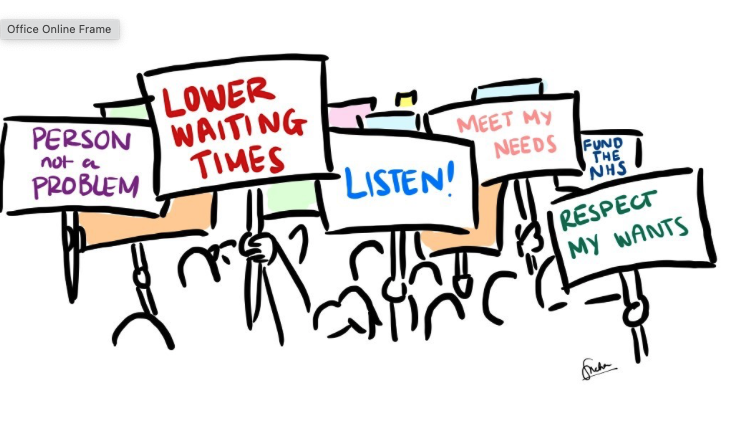
My drawing represents a protest with the signs all about things patients can advocate for themselves or things we as healthcare staff should advocate for them.
Effective Consulting, Year Two, 2024-2025
0 Comments