
It’ll get better on its own…
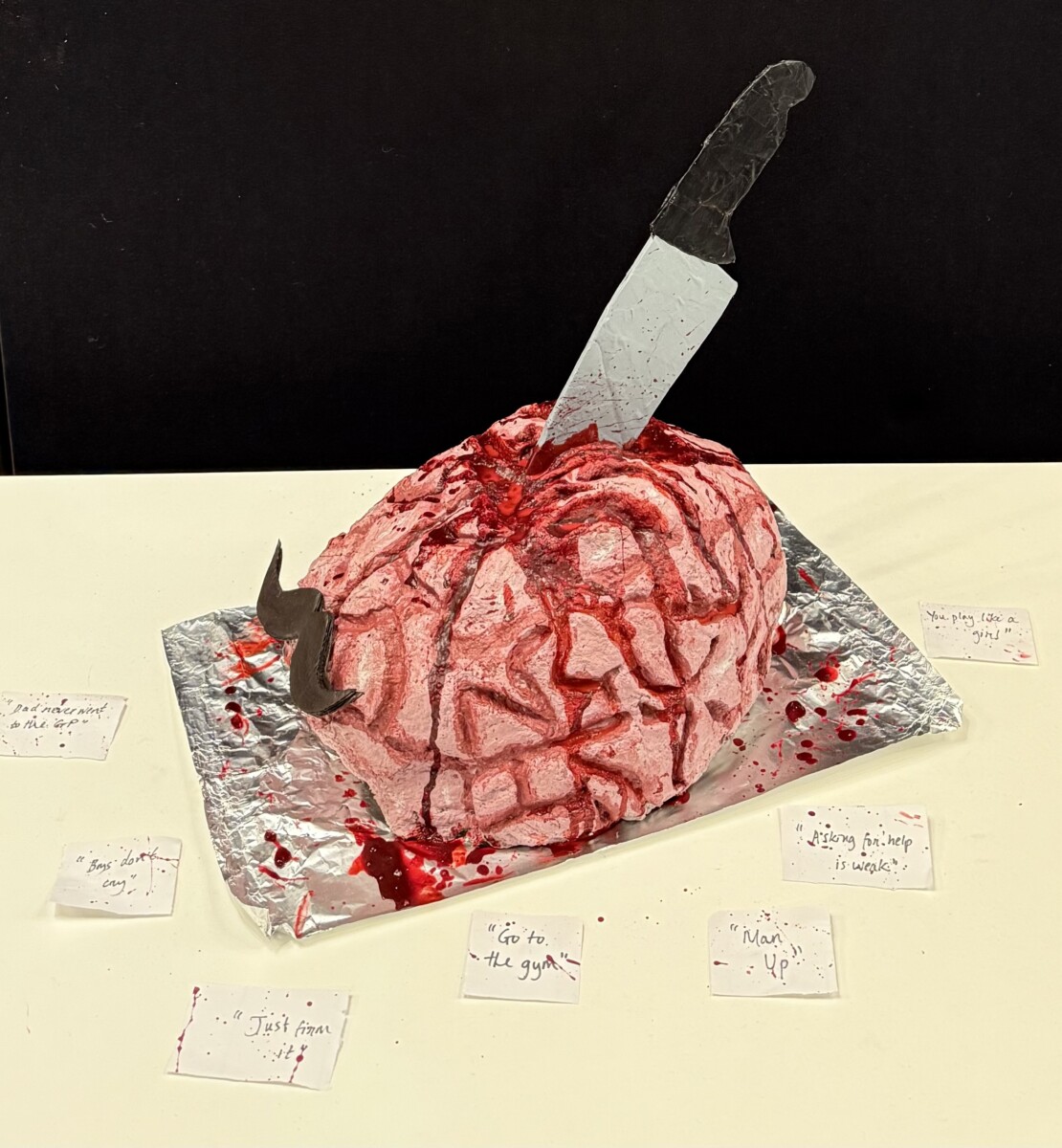
Group 1, Foundations of Medicine 2024





While it is true that so much of the human brain is still a mystery, extraordinary advances in our understanding mean that scientists and clinicians can offer therapies and treatments for many mental health and neurological disorders.
We wanted to explore the role that the male stereotypes might play in affecting a man’s perception of their own health for Men’s Mental Health month (November 2025), and what it means to be healthy.
We constructed a human brain, with distinct lobes. each having ‘developed evolutionary distinct and important functions’.
The frontal lobe, which makes us human, exhibits capabilities involving ‘judgement, abstract thinking, creativity, and maintaining social appropriateness’.
‘Man up’
The parietal lobe is ‘responsible for integrating sensory information, including touch, temperature, pressure and pain’.
‘Asking for help when you are in pain is weak’
The temporal lobe, ‘which processes auditory information and (with) the encoding of memory’.
‘Dad never went to the GP’
The Occipital lobe, ‘which acts as ‘the visual processing hub of your brain’.
‘I never see other boys cry’
The cerebellum, ‘which is primarily responsible for the co-ordination of movement, maintaining posture and balance, muscle tone, and motor learning.’
‘Just firm it’
For our sculpture, we created a model of a brain that has been dramatically and obviously injured.
In reality, a mental health or neurological disorder is invisible.
This creative enquiry is a comment on visible illness, the internal threshold for acknowledging suffering and ill health, and how this might be impacted by socialised masculinity.
Technology has provided a fascinating example of how something that is normalised as ‘just a mental health issue’ actually converges with observable and measurable neurological changes, which a lay person might be inclined to take more seriously. When an individual is clinically depressed, PET scans show lower overall metabolic activity in a ‘dim’ image. For this person, their internal lights have indeed gone out – and their world has become bleak. These murky scans contrast starkly with the sharply ‘illuminated’ brain of someone living without depression.
Ohona Hossain, Habibah Choudhry, Philippa Mitchell, Annie Tyagi and Alex Wong,
Year One, 2024/5
Foundation of Medicine Conference 2024 – Creative Prize-winner by peer vote
“It’ll get better on its own” depicts a knife dramatically embedded within a brain. Comparing the severity of mental health and neurological disorders to physical injury.
Each lobe of the brain is paired with comments that are often used in society which hold the viewpoint that men should have to cope with mental health issues on their own and that reaching out for help is “weak” and shows a fragile masculinity. This stigma within society is combatted by organisations such as Movember which aim to encourage men to express their feelings. Hence, the model of the brain is shown to have a moustache.
Furthermore, I found the irony of portraying a neurological disorder as a visible injury particularly striking when in reality these are invisible conditions. Showing the prominence of understanding that mental health problems may not always be obvious.