
The Role of Technology in Healthcare
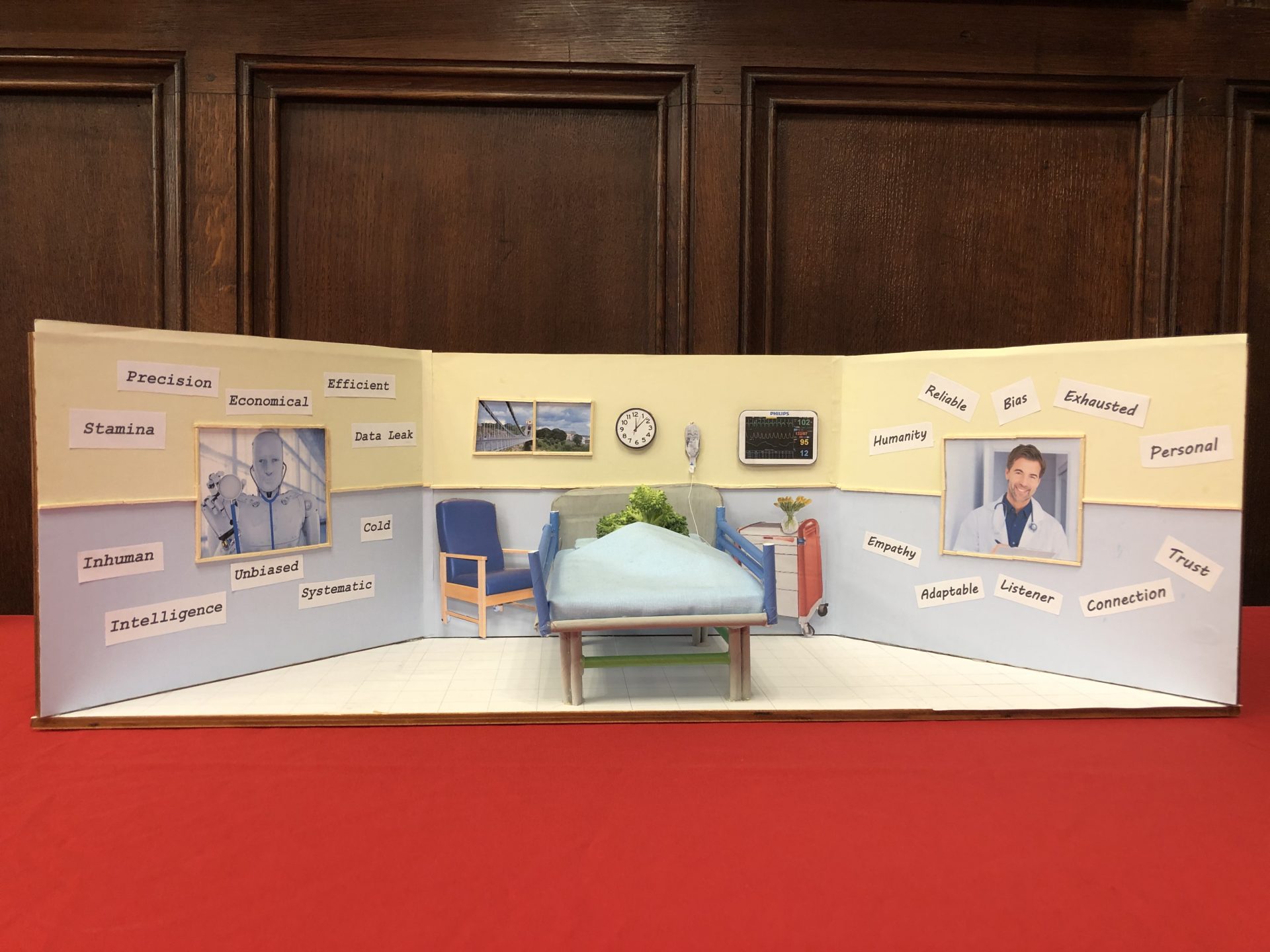
David Owen, Mihir Patel, Tolly Hoskins and Ella Dulake





An investigation into the quality of the hospital environment, laying out care- options by robotics and/or hospital staff and questioning our trust in artificial intelligence with a playful touch…and remarkably professional model-making skills.
I find the topic of artificial intelligence vs. healthcare professionals. In light of the COVID pandemic, we now see technology commonly used for online consultations. However, the debate around the use of artificial intelligence in diagnostic decisions and administering treatments has been ongoing for the past years. This art creation successfully outlines the many costs and benefits of artificial intelligence (inhuman, cold, systemic vs. precision, stamina, economical, efficiency, unbiased, systemic) and human doctors (biased, exhausted, fallible, inconsistent vs. personal, connection, empathy, listener, trust) in the the healthcare setting. With artificial intelligence, there may be more technical virtuosity, but something significant in medicine is lost through the use of machines; perhaps machines can help with making diagnostic decisions, but we still need doctors to heal.
2025 – its amazing at the moment the current revolution in healthcare about how AI can help shape treatments and give patients a way of accessing information about their condition that previously was harder to access.
technology is increasingly used to increase they efficacy of medicine in particular in consultations, treatment plans and diagnostics.
The art piece illustrates the advantages and disadvantages of AI
AI is cold and can feel detached but it is increasingly accurate/precise improving clinical outcomes.
but the decrease in people can lead to patients feeling a lack of empathy and feel its less personal/standardised