
Organ Manufacture
Group 4





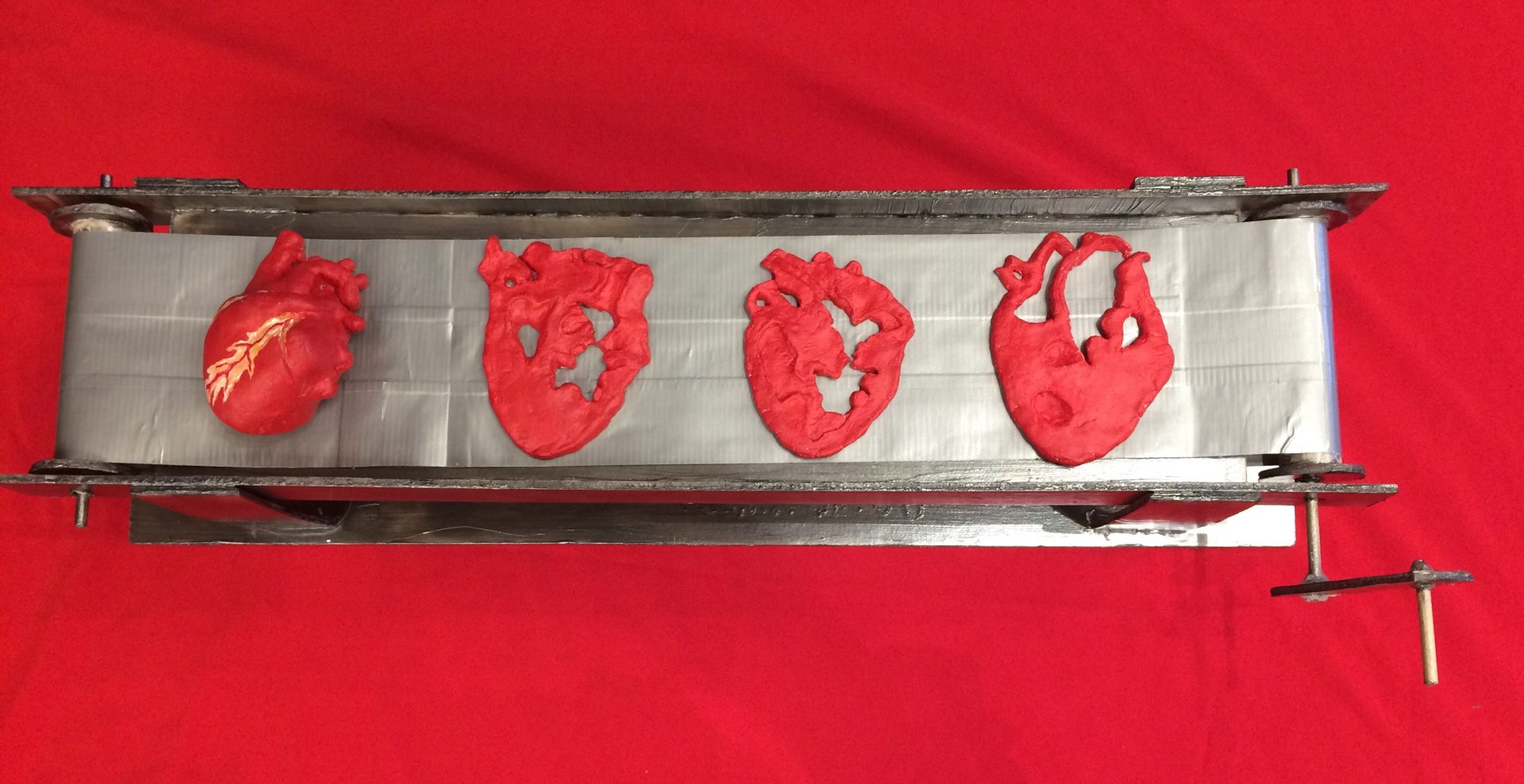
Exploring the contrasting perceptions of organ and full-body donation versus the reality of organ and full-body donation. Presented an acutely observed and researched imaginative projection of the 3-D printing a heart. This work raised many thought-provoking issues such as the potential de-valuation of our relationship with our bodies if we were able to readily replace ‘parts’ in a conveyor-belt manner and value-differentials in our internalized embodiment.
Saul Ethan Federman, Rosie Louise Fenton, Oceana Fernando, Loukas Ishwara Fiakkas, Amie Field, Ella Fisher, Maisy Flint, Chloe Victoria Flintham, James Felix Flynn, Grace Fountain, Amy Jade Fowler.
This work was later exhibited at a UoB/Bristol Museum and Art Gallery event ‘Leonardo: Between Art & Medicine’ led by the History of Art Department in April 2019 – a temporary exhibition alongside the touring ‘Leonardo’s Drawings’.
Year One, 2018 Exhibited at the Foundations of Medicine Student Conference,
I find this artwork really captivating. The physical piece in itself of a heart being manufactured on a conveyor belt is something I’ve never seen before and a really clever way of presenting the relationship we have with our bodies. It’s definitely thought-provoking, as mentioned, and makes me question whether if we were ‘able to readily replace’ organs in this manner, would this save more lives or would more lives require saving because we would be less appreciative of the bodies we already have? Perhaps it could reflect the future change in perspective in relation to organ donation and although the artwork depicts a heart being manufactured in four simple parts, it’s a contrast to how complex and precious the human body is.
I found this a very thought-provoking artwork. It seems very feasible in the not-too-distant future and we can all imagine this sort of scenario happening but there is something mechanical and cold about the conveyer belt. The dichotomy between the ease with which we can imagine this being our future but how detached it feels from our relationships with our bodies and how depersonalized it feels.
I think this piece is really interesting in terms of the literal and metaphorical meanings. Looking at it initially, the concept of a heart on a conveyor belt is uncomfortable, hence making the piece really effective in providing a route for the viewer into the question of ethics and organ manufacture. The different layers of the heart production further highlight the human detachment from this process, which again I think is really effective in raising those uncomfortable ethical questions. This feature also contributes to the reduction of human life to a factory process, which is interesting as it depicts us as more machine than living being. Overall, I think the piece is really intelligent and well executed.
This piece immediately captivated my attention when looking through the different submissions. This is because even with the simplicity of the piece, you immediately understand the message it is portraying. For me this piece represents two things. One being how we as medics may treat a donated organ as just an object needed to save lives, when in fact it used to belong to another human being and to be able to save one person, another had to die. The other thing it represents to me is the developing science of organ printing and the hope that that brings to the donation system. When printing organs one day becomes feasible this will then mean that people requiring a transplant are no longer hoping for someone to die, they can receive an organ free of guilt of someone else losing a life.
This piece emphasises to me a major potential change that medicine may face in the (near?) future. As human organs lose their natural value becoming “manufacturable”, it may become easy to forget a time when we relied on human organ donation. Naturally this would be a sensational development for medicine, with the possibility to change the lives of so many patients and their families. However, to me, there is artistry in the combination of a donated organ with a recipient and a beauty in their subsequent function as one.
This is certainly not the end of such artistry but a transition into a new artform. If 3D printing of human tissue became very prevalent, there would be a clear movement away from a “natural” body and towards a union of natural tissue and manufactured tissue. This is perfectly presented by the juxtaposition of the heart sections against the industrial conveyor belt in the model. The piece’s simplicity forces you to consider this alien possibility. I have found this art piece to be a very interesting prompt to consider the implications of manufactured body parts on views on healthcare and wonder how far away such advancements are from becoming mainstream and normal practice.
I found this artwork very captivating, in regard to both the topic it depicts and its presentation. The topic of being able to manufacture organs is not so far-fetched, and can even be seen to be something that can arise in the near future however, this piece grasps at the way that our relationships with our bodies would shift as a result of this development.
The cold, metallic convey belt stands out and contrasts with both the red background and the heart, highlighting the more distant, consumerist attitude that could arise with the rise of 3D printed organs, potentially making us lose sight of the value of organs themselves. I think this is the strength of this piece, it creates the idea that, as time progresses, we may even devalue the organs that we receive from other humans, forgetting the fact that the organ has come from someone who has willingly decided to give up an essential part of themselves, for the benefit of others. This idea is essential to remember when being a Healthcare professional, as it is something vital that must not be forgotten, lest we reduce an organ donor’s rare, irreplaceable gift to something commonplace.
The other thing I find myself feeling is excitement for the future of medicine, as the turning handle of the conveyor belt suggests it is human actions that turn the wheels of development and give rise to life-changing medicines and procedures, which can drastically alter the treatment plan of patients and improve their quality of life. This is something that will continue to happen every generation, resulting in continued improvement of treatments, all to benefit others, done by humans themselves.
Overall, I think the piece really excels at making you think of the implications of introducing life-changing treatment to society and what can be the impacts of this.